American Psycho (2014 Original London Cast Recording)

Feeling tired? Low energy? Bored? You might need the 2014 West End Recording of Duncan Sheik’s American Psycho. It begins with:

“It took me 19 years, but I finally developed a good relationship… with my body!”

Suddenly a high, shrill, terrifying shriek. Next comes the synthesizer with a high energy intro. You begin to hear overlapping advertisements from the 1980s. The piano and beat enter the mix and Matt Smith Patrick Bateman starts telling you about his morning shower routine. Only took 30 seconds into the first track to cause my heartrate to rise, and honestly, from then on the entire album carries you through a 1980s electro drug induced party party party haze. And. It’s. Awesome.

Duncan Sheik’s American Psycho was short lived when it premiered in London in 2014, lasting only a few months. And it was even shorter lived less successful with the 2016 Broadway transfer. Poor, poor American Psycho only lasted for 6 weeks on Broadway. I will admit, it’s a strange listen, and perhaps the visuals of the stage production, which are amazing, are needed to fully understand what Sheik was trying to accomplish, musically. To me, that is often a sign that I won’t be impressed by the score. An example of this is Dear Evan Hansen. Great music but the songs could be used for a musical about literally anything. In fact, one might argue that the music doesn’t even quite match the emotional complexity of the story.

But I digress. After his successful freshman Broadway hit musical Spring Awakening, he had raised the bar incredibly high for any future musicals. And it’s obvious that Sheik wanted to try something that wasn’t going to be Spring Awakening 2.0. And, as such, we have American Psycho.

Unlike some Cast Albums, it’s hard for me to point out highlights, as the album feels more like one long song. One of my favorite moments occurs in the first act when the ladies are preparing the party. To highlight the blocking/choreography/lighting, check out the dance break around the 1:45 min mark. First time I saw it my jaw dropped. Worth watching from the beginning for the full experience. Great song.

Overall a great album that often gets overlooked for reasons discussed above. I’m glad it at least got a stellar cast recording, even though the productions were less successful. I would, in all honesty, like Duncan Sheik to take another look at the score in a few years, and maybe give us a American Psycho revised 2.0. I think the score has a decent amount of potential to be even better than it already is. I’ll be looking to see what Sheik works on after Covid lockdown.

Sound of Music, The (1981 London Revival Cast Recording)


It’s hard to analyze Sound of Music without noting Julie Andrews performance in the classic film, so I’ll get the Julie chat out of the way here. Imagine a world where the movie was never made, and the only Maria’s that ever existed were those who played her on stage. Petula Clark would have been Maria 2.0 after Mary Martin’s original Broadway performance in 19XX. 1981 was the beginning of a new era of musical theatre. The decade would soon be defined by Webber, Sondheim, Yeston, Shonburg, and Richard Rodgers was now a full generation past. In the spirit of keeping older shows relevant, I think the 1981 Cast Recording is a fine adaptation of the Rodgers and Hammerstein classic.

The brass fanfare ushers us into the sound of music. Woodwinds chatter amongst the whispering percussion and horns, We are transported to the pristine mountains of Switzerland(?). The helicopter view of Julie Andrews twirling around is embedded in your memory if you were born before 1990. If you never saw the film, just know that it’s amazing. The orchestra builds, and builds, and builds and stops(!) on a single note played on a violin… And Petula Clark’s voice begins:

“My day in the hills has come to an end, I know. [Ding.]”

With this one line, she reaches out and grabs your attention and mesmerizes you for 10 seconds, calming all nerves, and quelling any fears that your expectations won’t be met. Her vocal tone against the horns is so beautiful. She continues to the climax of
“The hills are alive…!” and my heart is full of joy. By the end of the number, she has shown us a full range of dynamics and vocal tone. Clark has a lot of potential for this show, I think. And she gives her own smooth twist on the classic role that I grew up adoring.

Clark’s take on I Have Confidence is unique in that her confidence is not shrouded in nervousness, but rather shrouded in excitement. She begins the song quiet and timid enough, and her nerves come across as eager jitters. For the second half of the show, she’s ecstatic and gives us the Petula Clark belt-and-slur high notes that we can expect. The song ends with an over-the-top Seventy Six Trombones marching band situation, but it’s a good track, and a personal favorite of mine.

As Sound of Music entered the crazy 80s, I believe the music represented Rodgers’ work well, and Petula Clark made the character her own. This is usually my go to album if I’m in the mood for Petula Clark, which is, these days, often.

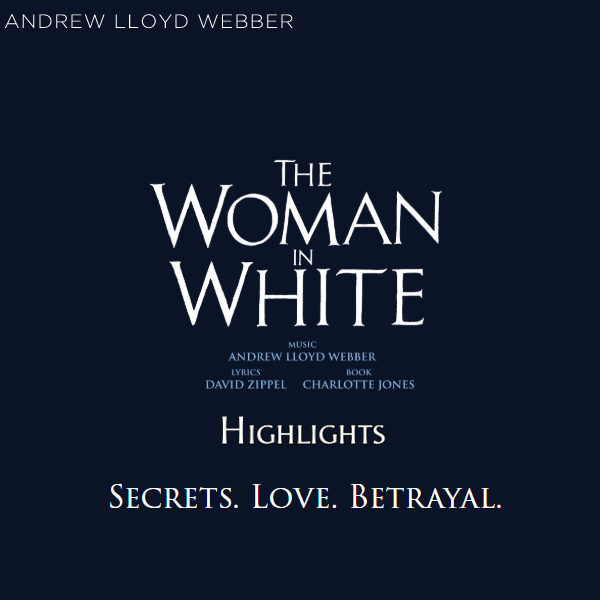
The Woman in White (2004 London Unofficial Highlights)

Poor, poor Woman in White. After her lukewarm Broadway run she disappeared into the shadows for over a decade. My impression is that US audiences found it boring and UK audiences found it… acceptable? I was a teenager when I bought the CD in 2005 and I was truly, deeply, madly in love with the score. I don’t know why, and I know my teenage hormotional rollercoaster adds a nostalgia bias. But damn, the music in this show is just gorgeous. I would like to point out that I’ve never seen this show and its visuals (which I’ve heard were at least good) are only in my imagination.

In highschool, this is what I assumed: Woman in White was never given was a proper, solid cast recording. The budget for the album was definitely 45ish$ that went to the soundboard guy to press the record button at the beginning of the show and the stop button at the end of the show. The album is, literally, a full unabridged recording of the show with no edits, cuts, or adjustments. Oh, except for a bonus track which is identical to a track we just heard near the end of Act II. The album finishes with a clunky, bumpy song that follows a beautiful finale. This album is so beautiful but much too complete and full of dialouge for me to recommend it to a present-day theater enthusiast. As a result, I made an abridged version for my own personal use and to share with friends.

Act 1: We begin with a dark frightning encounter between our protagonist(?) and the epynomous woman in white. I actually love this opening; it starts with the sound of fast moris code style clicking contrasted against an slower, offtempo sounding brass/woodwind that continues to build. And then suddenly a man screams “Oh my God!” and this driving 4/4 ascending piano bit starts and the two characters have a songversation. We are then introduced to the woman in white’s signiture theme (“You see I am no ghost” melody) with Angela Christian belting a tune so haunting it will give you goosebumps.

Following the prolouge, the tunes become uplifted as the characters are introduced and the score moves towards an almost “pastoral” 1850s painting vibe. Despite a somewhat slow to build beginning and ALWs absolute refusal to include any harmony in the duet “I believe my heart,” I am eager to hear more.

After two rousing renditions of Lammastide, a song which is creepy, repetative, and, entirely forgettable. It sounds like Andrew forgot how to write pop music momentarily as the chorus singing (again, no harmony) a robotic melody with a flute-accented downbeat so heavy, it kind of makes you motion sick.

Good news is that following Lammastide, the real beauty begins with the Holly and Ivy songversation into Maria Friedman’s tragic All For Laura. And then finally, the 3rd or 4th reprise of You See I Am No Ghost as the finale. In the edited recording I posted, the finale is cut a milli-second too short to breathe between Acts, but honestly, the actual final seconds are not noteworthy. When I remake this edit with a FLAC rip, I will change the akwardness of this track, and add a couple seconds to breathe before Act 2, and add back in the church bells indicating the beginning of Act 2.

[Intermission]
Wow. I don’t know why harmony-less duets bother me so much. Am I missing something? Why wouldn’t you harmonize in a 4 minute love-ish song? What is it exactly about this melody that allows it to be acceptable without harmony? Am I over-reacting? Probably.

Act 2 begins with churchbells, which I edited out originally, oops. We get a few great solos, notably Evermore Without You, All For Laura Reprise, and You Can Get Away With Anything. And we also get treated with Lost Souls, a personal favorite of mine. It’s a fast paced choral number in 7/8 time, a catchy melody, and, thank you Jesus, harmonies galore.

The Finale is dialog driven, but there’s a nice medley of tunes from the show to underscore the creepy ending. At the very end, we get, the 18th reprise of You See I Am No Ghost (Okay, 5th?) and we finish the show with a ton of grunting and groaning and slapping from what is clearly a 2-minute fight onstage that we cannot see. The 12 minute finale I only cut down to 9 minutes, and it’s still awfully long. Especially with all the noisy stage fighting, it doesn’t make for a great listen.

But. Woman in White will always be one of my favorite broadway “flops” and I hope to see it return someday. (Worth noting, I know there was a 2017 West End revival, but there is little media from it and I never saw it). Maybe next time with a well produced cast album 😀


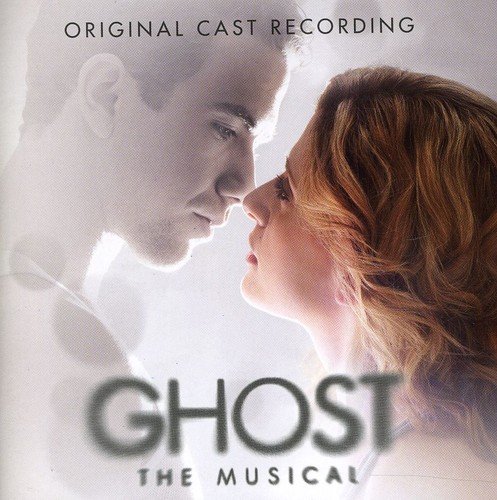
Ghost (2011 London Cast Recording)

Full disclosure: this recording is not my favorite. Don’t let my grumpyness disuade you from eating up what Cassie has to offer though.

Enough time has passed since seeing the original Ghost film that I don’t remember anything except for Demi Moore’s haircut, which was unforgivable. The broadway production somehow went unnoticed by me during the early 2010s “Movie-turned-musical but only lasting a few months on broadway” situation. And Ghost was never a movie I ever considered for a stage adaptation, as I believed it to be locked in the 1990s vault for all time. I didn’t know who Cassie Levy was, nor did I know that Glen Ballard (of Jagged Little Pill fame) and Dave Stewart (of Eurythmics fame) composed the show. After obsessing over Cassie’s Elphaba, Elsa, and Fantine performances in recent years, I finally decided to give the album a new listen. After all, Cassie’s hair is much prettier than Demi Moores, so maybe there’s hope.

Act 1 – The show starts with characters Molly and Sam singing some cheesy pop songs (including a non-favorite song of mine, Unchained Melody) and suddenly Sam gets by a random Mexicann mugger, and then there’s a seemingly out of place song-and-dance tap number “Ball of Wax” set in a hospital and by this point in the album, I’m not sure where to put my emotions. Following this confusing number, a gospel number comes out of nowhere asking Molly and the audience “Are you a believer?” Am I sad? Confused? Cringing? Am I a believer? I’m not sure yet.

Finally near the end of Act 1, Cassie blesses us with the ballad “With You.” This is beautifully belting fantastic Cassie Levy in all her glory singing a great pop song with a haunting minor lift in the chorus (With youuuuuuuuuuuuuuuuuuu-oooooooooh). And finally the Act one finale comes and Molly “suspends her disbelief” with a 10 minute rock track with so much overlapping dialog and singing and another mexican bad guy? I’m not sure. Now I realize that I have no idea what the heck this musical is about. I’m hoping the second act is… less… confusing.

[Intermission]
(You know how in A L Webber’s Joseph/Dreamcoat, every scene is a new music genre? Country line dancing into French accordian cliche ballad into calypso jam into 1970s disco jam “go go go joseph” into a sad ballad, into 1980s megamix. By the end, your brain is like “what is happening what universe does this story take place in and I feel lost” Ghost is – not as intense – but I wouldn’t say the score “flows” well. And I’m not sure why so many genres are being represented or what the writers “want” me to feel.


Act 2 takes us through ballad after ballad after ongoing dialogs about psychics and ghosts and love. Okay. This is fine. I’ve now read the synopsis and kind of get the gist, but near the end of the album, the not-so rockin’ rock song “I’m outta here” bleeds into an incredibly long dialog track / unchained melody reprise. It’s not until this track is over that I realize we’ve reached the actual finale of the show. Sam stops following around Molly and says goodbye in what is a very quiet anti-climatic ending. And now she has closure? I’m not sure. Do I have closure?! Even less sure.

The album concludes, after the finale, with a pop duet version of “With You” which is enjoyable. It remains the only track I can remember the melody of – everything else is a confusing blur.

Now, with all that being said, I will be keeping my eye out for future productions to see how the show has evolved as it seems to be staying alive somewhat across the pond in the European market. I actually do recommend the recording, dispite what looks like a long list of complaints (Sorry Glen Ballard) simply for Cassie Levy’s vocal performance. She could sing happy birthday backwards, drunk and with a pillow case over her head and I would probably still enjoy listening to it.

Ghost the Musical in its 2011 form is definitely a clunky mess of a musical. Fairly empty with brief moments of quality. Kudos to Cassie and Richard Fleeshman for trying to hold this erratic score together. I think I’ll stick to Jagged Little Pill or Frozen if I need to scratch my Glenn Ballard or Cassie Levy itch.