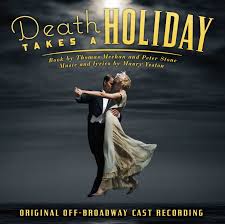
Death Takes a Holiday (2011 Original Off-Broadway Cast Recording)

I will keep this essay short. Yeston’s scores and librettos are so crisp and clean and beautiful. Honestly I listened to this album 3 times in a row before writing this essay, and I’m mostly lost for words in it’s beauty.

With his pit pit patter of raindrops sounding first few measures of the album leading into this quiet trumpet(?) drawing you into the first vocal line “In the middle of your life.” This is classic Yeston. It’s quite apparent that Yeston writes both the score and libretto. The two blend together in a way that makes each character’s voice feel like another piece in the “Yeston Soaring and Heavenly Melodies” orchestra. This is similar in taste to his Titanic score, and in the best way possible, 14 years later. What a joy!

Like a good book, Yeston’s scores are a great example of a”page turning” style of songwriting, where each track/scene is so musically intruiging that it’s hard not to get excited to hear what comes next. Each song in Death Takes a Holiday transitions seemingly seemlessly smoothly to the next. Even though there are dialog transitions, and obvious silence between scenes, the album still feels like one long beautiful song. This style, if executed well “correctly”, works well with critics and audiences as we saw with Yeston’s Titanic, Sondheim’s Passion, ALW’s Aspects of Love.

Yeston doesn’t strench his lyrics too thin or two broadly. The connections between syllable structure and musicality/time signitures rhythm is really smooth and pleasing to the ears. You know when it feels like the lyricist tries to fit 10 syllables into half a measure? This score/libretto has none of that. There is no bumpiness or clunckiness to the words being said, and the dialog transitions seemlessly into the orchestra as new song begins.

In short, Death Takes a Holiday’s score is nothing short of gorgeous. Listen to it.

Yeston-Kopit’s Phantom (2016 Korean Cast Recording)

This post refers specifically to the Park Eun Tae Version of this production.

Remember back in 2000 when Lippa and LaChuisa both had shows based on the same source material, both in NY, and both named Wild Party? Weird that it happened right? I also remember the Yeston’s Titanic coming out the same year as the blockbuster film. Also somewhat akward. Well, a kind-of similar thing happened about 15 years prior with Gaston Leroux’s Phantom of the Opera. This is not totally unheard of; think about A Christmas Carol adaptations, any musical about the last days of Jesus, The Little Prince adapations, modern adaptations of Shakespeare, and on and on. In the mid 1980s, three shows based on Leroux’s Phantom were in works. One by Ken Hill, one by Maury Yeston, and obviously, the big one: Andew Lloyd Webber’s Phantom of the Opera. It would be an understatement to say Webber’s production “won the race,” as, not only did it win the race, it is literally still in it’s original run on Broadway. a staggering 30 years later and Webber’s musical remains intact, successful, and extremely well recieved by theatergoers. Myself included. Hill’s and Yeston’s Phantom typically go unnoticed, and are seldom mentioned in theater small-talk in my circles.

When I learned about Yeston’s Phantom in high school, even though I was a fan of Nine and Titanic, I didn’t have much interest in listening to the recording because I knew it would be hard for me to seperate the two shows in my mind. And indeed it was hard for me to listen through the American recording as there was too much conflict in visualizations.

I came to this realization very recently, actually, and decided to try listening to a non-English version as to break the connection. And much to my delight, it worked. The 2016 Korean recording is exhilerating and, for me, something fresh and new from one of my, if not my absolute, favorite composers.

With the exception with the use of the name Christine, I do not hear anything in the Korean translation of Kopits libretto that reminds me of Webbers. Also worth mentioning I am a native English speaker and speak no Korean except for what I learned from playing Starcraft back in the day. The two shows are drastically different in terms of music, and it would be completely useless to try to compare the two. IfI had to dig for similarities, I would point out that Webber’s “Play within a play” music (Hannibal, Think of Me (sort of), Don Juan Triumphant, etc.) retains a 1880s Creepy Opera House feel, while the rest of the show is overtly 1980s Creepy Rock-Opera feel. Yeston’s score is the former version of creepy, for the entire show. Even the melody melody melody melody major chord song(s) are creepy.

Yeston’s score has so many complexities and nuanced features and everytime you listen, you hear something new, it is one of those scores that grows and grows on you. With Webber, you can see the show twice and have all the songs memorized and stuck in your head for 30 years.


Nine (1982 Original Broadway Cast Recording)

Maury Yeston’s Nine (1982 Original Broadway Cast Recording)

Act 1
:
I was introduced to Nine around 2003 when the revival cast recording was released. As a teenager, I bought the CD on a whim, having never seen the show, but Yeston had an impressive reputation, and he had two major league shows win Best Musical at the tony’s by this point, and Jane Krakowski had some press coverage with her descending-from-the-ceiling-upside-down knockout performance of “A Call From The Vatican” (seen here if interested: https://youtu.be/UvhMAw6gCDw. Hearing Anita Morris’s version of the showstopper is a treat. Her almost manic finale combining belting, crying, high soprano notes, and vocal shivers, is really something else.

I did pause my listen-through of the 1982 Broadway Recording to reminisce on Jane Krakowski’s variation from the 2003 Revival, and I will admit, there is something almost perfect about Jane’s vocal rendition. I also, for the sake of objectivism(?), listened to the London (Becky Norman), Australian, Movie (P Cruz) and “Maury Yeston Songbook” (Alice Ripley) versions of the track as well.

The second half of act one unfolds with lush orchestrations and theatrical vocals with an obvious attention to the loony-ness and psychosis of some of the characters. Even in longer numbers like “Follies Bergeres”, and long song-and-dance-and-drama number sung in Franglais, where I literally don’t understand what’s happening for 8 minutes, Yeston’s score pulls me in deep regardless. It’s actually memorizing to hear the complexities of the overlays of vocals and orchestrations in this number. It reminds me of how good Les Miserable’s showstopper “One Day More”, or Rent’s “Christmas Bells” can be, even though it’s impossible to understand what anyone is saying.

The eponymous lullaby/choral number “Nine” sounds like it was written for his show Titanic, with a soaring melody and never a missed opportunity for flute heavy orchestration. Titanic, premiering in 1997 around 15 years after Nine, feels more like one long orchestral work turned into a musical, rather than a play with songs. (Also worth noting that Titanic is one of my favorite musicals and won the 1997 Best Musical Tony). The song “Nine” is later recorded as more of a solo number in the 2003 revival, where it loses some of his angelic, lullaby-esque feel.

By the time the Act 1 Finale track comes, I realize that every track so far has been extremely diverse in its musicality, while also maintaining a very classic Maury Yeston feel.

[Intermission]
A, very opinionated, side note: Maury Yeston’s Compilation album “Maury Yeston Songbook” is an essential album that belongs in every theatergoer’s collection. If for nothing else but Betty Buckley’s insane interpretation of Nine’s “Be On Your Own”

Act 2
Act 2’s favorite numbers for me include Be On Your Own and Unusual Way, but the Broadway recording doesn’t have the same oomph for these numbers as future recordings will. It might be worth it for me to compile the entire score as a playlist with my favorite versions from each recording, as it seems to vary widely among the songs. As well there are songs added from the motion picture soundtrack. Maury Yeston’s Nine was chosen to listen-through today because I haven’t given it a proper listen in years, and I’ve been on a Maury Yeston kick, having recently obtaining his Tom Sawyer ballet, as well as re listening to Titanic.

Concluding Thoughts
In short, this musical is amazing, and the score is enough to keep you enthralled, even if you know nothing of the story-line. The second act is stronger in future recordings, but nevertheless a fantastic album. Maury Yeston is an American treasure, I hope his works live until forever.