Robert Lopez, as well his wife Kristen Anderson-Lopez, are strong power players in the musical composer arena. Robert’s early success with Avenue Q lead to his ability to turn music to gold (let it go) with collaboration with his wife. While only moderately prolific with Broadway musicals, both R Lopez and K Anderson-Lopez are very young and I anticipate them being big hitters when Broadway returns from the grave. I will spare you the time, and energy, and not go into detail as to why Let It Go is literally the best song ever written, and it’s no surprise to me that R Lopez has as EGOT x2.
But I digress. Book of Mormon is right up against the border of my tolerance of obscenities. I’m not a huge Parker/Stone fan, and never really “got into” South Park. Their signature crudeness for the sake of being crude elicits a wide spectrum of reactions from the audience. Despite its lyrics, it is so funny, that, for me, the humor completely overshadows the foulness.
I would argue that Lopez’s score helped did carry boost the show to its current standing as a Broadway hit, and softened some of the harsh elements of racism and religion bashing. At the end of the day, I love the show, and I always end up going back to the OBCR and giving it a good listen.
The Church of the Latter Day Saints took the parody of it’s sacred text in stride and took the punches as gracefully as possible. As offensive as it is, its level of parody assures the audience that it is not a direct attack on the Mormon community.
Highlights of the album are the opening numbers Hello, Two by Two, and You and Me, as well as Baptize Me, and the amazing Act One finale Man Up, the latter being my personal favorite. If BOM is not in your collection yet, check the link above.
Broadway
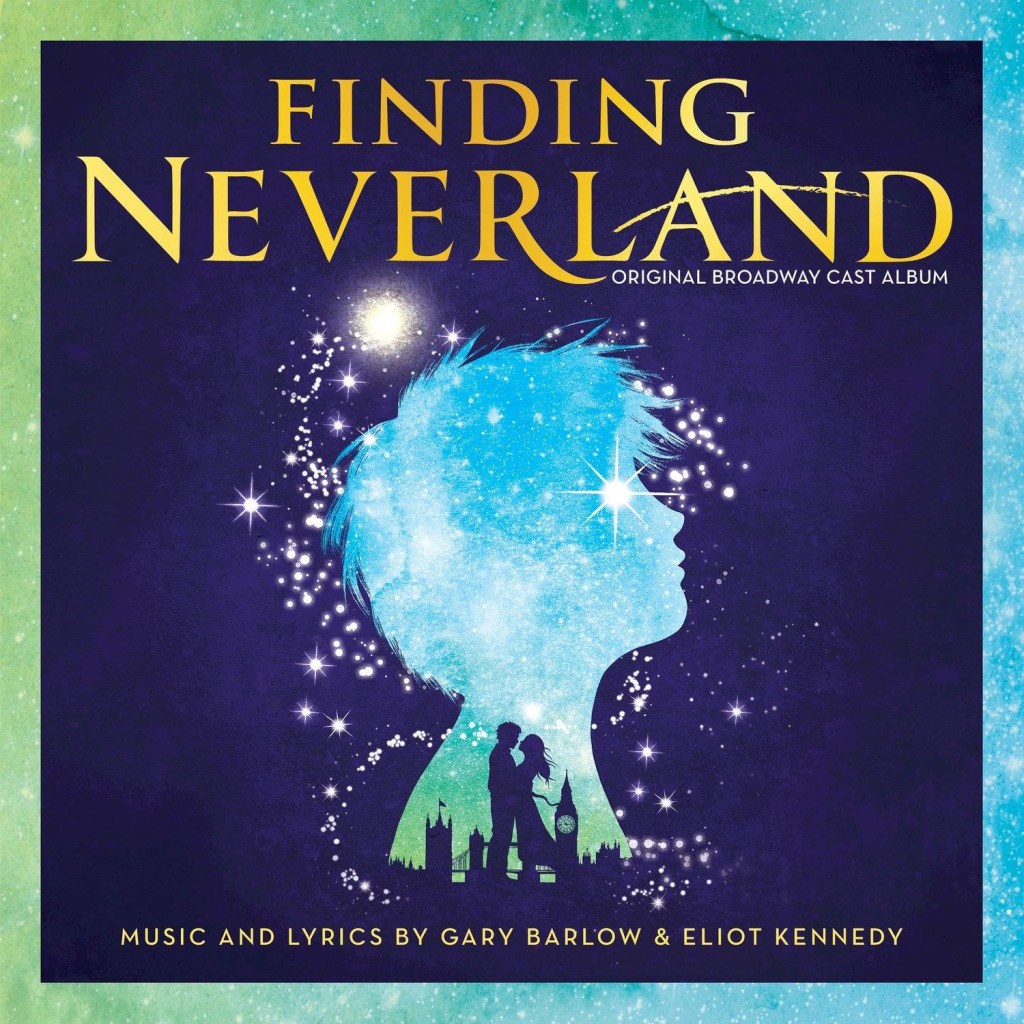
Finding Neverland (2015 Original Broadway Cast Recording)
I am not entirely sure what was happening in my life in 2015 to have this production fly completely off my radar, but indeed it did. I will admit that I am not a huge Peter Pan fan. I suppose the story of not wanting to grow up doesn’t align with my childhood in any way. In fact, I was eager and ambitious to grow up and be an adult as soon as possible, to a fault I presume.
But Peter Pan is an enduring, classic story, and in this version we follow the author on an adventure of imagination. Based on the 2004 film of the same name, Finding Neverland is one of few Broadway musicals whose workshop version has a completely different composer than the final product. I understand that a few remnants of Scott Frankel’s original 2012 score remain intact, but the music is now mainly attributed to Barlow and Kennedy.
After taking a brief glance at the 2015 compilation album “Finding Neverland the Album,” I was certainly impressed, or rather, star struck by the number and variety of artists who contributed to it, so I decided to give the OBCR a try after hearing Ellie Goulding sing what is now my favorite song from the second act of the show, titled When Your Feet Don’t Touch the Ground.
The album begins with a few catchy enough songs, each song is bouncy, adventure themed, poppy, and somewhat forgettable. But what all this is leading to is two (2!) back-to-back Laura Michelle Kelly solos. The first, a power ballad, the second, a lullaby. Then the score starts to unfold and make a little more sense by the time the title track “Neverland” is heard. Matthew Morrison has me sold on finishing the album. The songs in the second half of the album are really exciting. Composers Barlow & Kennedy’ really capture the feeling of soaring, seeking adventure, under-the-stars, twinkle-fairytale-ness.
After Neverland, we are met with a ridiculous track Circus of your Mind. This is the first stand out track where both Kelsey Grammar and Carolee Carmello are featured. It’s a pleasure to hear Frasier Grammar on this recording as I’ve been a big fan of his since I was a small child. As well he is in very, very few cast recordings. And then Carmello, who I know most from the original run of Parade, is always a powerhouse to have.
The rest of the album is super great, and there are too many little moments of delight for me to write down. One is when Morrison is singing Stronger and Grammar is in the background having this fit of yelling that adds a call and response to the melody. It’s really cute and sound great. Here is Morrison and Grammar performing Stronger at the Tonys:
Another moment of delight would be the bit in World is Upside Down where they are trying to clarify the semantics of the word “lost.”
“Is he lost in a emotional purgatory? Or lost in an existential search for himself?
(…No he’s just lost.)
Good heavens! Where, when, and how?
(Do you have experience being lost?)
We’re experiencing it now!“
Leading us up to the end of the show, Morrison sings When Your Feet Don’t Touch the Ground, which is, as mentioned above, the 11oclock number in this show. It really pulls me in, as a listener, and propels me into the finale. The finale is lovely enough, and the bonus version of the song Play is a delightful!
I will admit the actors, who are just so, so, so, so strong, really carry some of the less memorable musical numbers. Grammar, Morrison, LM Kelly, and Carmello really show how much good acting adds to the overall listening experience. The four of them definitely sell the album for me.
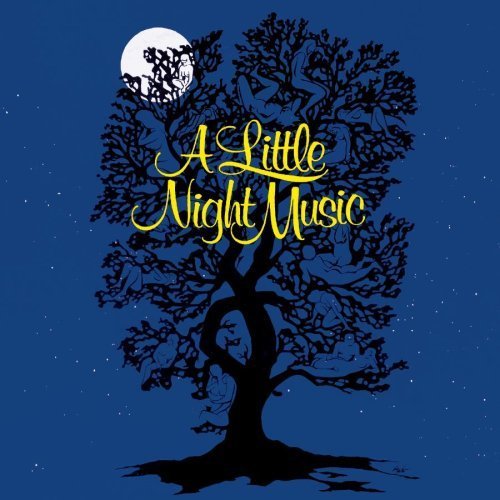
A Little Night Music (1973 Original Broadway Cast Recording)

By 1973, Sondheim had already made a name for himself as master composer/lyricist, and with his two prior shows Follies and Company, he had set the bar incredibly high for himself. Needless to say, he has a magical quality of exceeding expectations.
The recording begins with a bizarre overture in which lead singers bellow operetta-esque phrases of non-sense, all in 3/4 time. In fact, with very few exceptions, Sondheim does not deviate from the time signature, although he adds variations to the theme often. Due to his creativity, and sense of musicality I suppose, the show doesn’t feel “stuck” in 3/4, and definitely has a natural ebb and flow to it. The opening solo, a personal favorite of mine, Now, begins shortly after with a quick duplet(?) phrase introducing a line only Sondheim could write:
“Now, as the sweet imbecilities tumble so lavishly onto her lap”
We are quickly thrown into the inner thoughts sung by the man, which the female character responds, though not directly, in speech. The impeccable timing of both characters is stunning, and if you close your eyes and pretend to be the composer of the song, you will likely get lost within the first 10 seconds. The juxtaposition of the manic ramblings of the man, against the almost blasé, underwhelmed tempo of the woman, makes this song an auditory treat.
Sondheim would not just leave us with Now, though. After Now comes the song Later, a slow ballad sung by a troubled young man, Henrik, in anguish at how it’s “intolerable being tolerated,” and how easy it is to feel ignored. He forcefully delivers a descending line near the end, the climax, exclaiming:
“How can I wait around for later? I’ll be ninety on my deathbed and the late, or, rather, later, Henrik Egerman.”
After the less traditional melody of Later, we are graced with the female solo Soon. Of the three melodies, Now, Later, and Soon, Soon appears the most stable and structured out of the three, and this is important because near the end of Soon, Sondheim asks all three actors to join together in a trio in which Now, Later, and Soon are all sung simultaneously, with the slower melodic proceedings of Soon acting as the glue holding everything together.
The trio of the three dissimilar melodies highlights Sondheim’s ability to craft a structured group number using the building blocks of three distinctly unique melodies, tangled together in a interwoven web of emotional disfunction, counterpoint melodies, and, of course, a triplet time signature.
The entire track is, needless to say, really well executed, and, for me, breathtaking.
Another gem on this album is the alternate take version of Glamourous Life, added as a bonus track on the album.
Most certainly a quirky and wonderful tune. I feel that it is woven together by piano/orchestral triplets and a sweeping melody. The song sounds like it would fit into modern musical theatre quite well, at least more so than some of the other tracks.
And finally, I can’t talk about A Little Night Music without mentioning Glynis Johns, with whom I was introduced to as a child via Mary Poppins. Johns delivers a stunning performance of Send in the Clowns. There has never been, and will never be, another Glynis Johns. Her voice will always bring me joy, nostalgia, and, sometimes, tears.
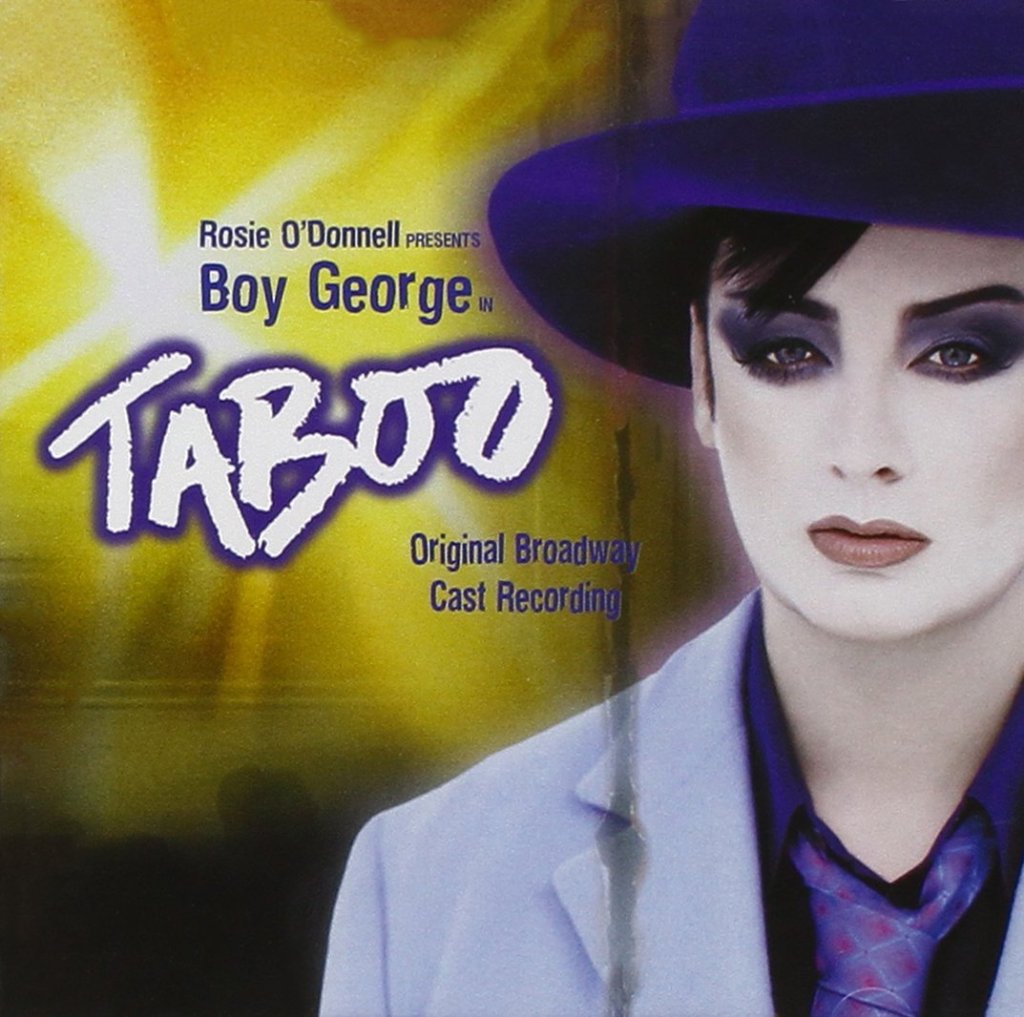
Taboo (2003 Original Broadway Cast Recording)
Boy, oh, Boy George. Why are you so weird and why do I love this album so much? Not sure, but let’s take a look:
In the early 2000s, Rosie O’Donnell, America’s leader in daytime talkshows and Lesbian family values, decides to finance the entire (short lived) Broadway run of the semi-successful West End Boy George biopic play (biopsical?) Taboo. Some of the libretto is, yes, tasteless, filthy, and unneccesarily descriptive, with the Act 1 song titled “I’ll Have You All” seemingly the main source of depravity. There is fairly descriptive insight into Boy George’s moral influences and the dark world of the 1980s London gay sex club scene. I’m not sure if 2003 America really understood what was happening on stage, as I’ve never really considered Boy George a major celebrity or role model in any way on this side of the pond. Additionally, in retrospect, it was slightly a creepy showcase considering his “legal troubles” involving kidnapping, chaining to a wall, and then beating a male escort with a metal chain horrifying acts of violence only a few years later. After this and a string of other not-so-great stories in the mid/late 2000s, I slid my copy of Taboo into a drawer and let it collect dust for many years. I never wanted to associate myself with Boy George when I was young and teenage me felt almost betrayed when I heard about his history of violent behaviour.
Despite the confusing story, weird vibes, and an akward introduction (for many Americans, or rather, at least for me) to Leigh Bowery, I will admit the recreations of costumes, lights, and sounds, are entertaining and dazzling, and make for good theatre. In addition to the dazzle of the exciting gay nightclub scene, we are treated to, not a Boy George jukebox musical, but rather an original score. Yes, we get to hear Karma Chameleon and Do You Really Want to Hurt Me?, but only in short snippits, and George’s music from the 1980s is not the focus of the score.
Act 1 is a whirlwind of druguse, sexual devience, and cross dressing and we are introduced to about 10 different characters, some male, some female, and some inbetween, who all play a role in the story telling. I will admit it is hard to bring myself to fully empathize with George’s story, and I can’t keep track of the characters, but there’s something about this show that draws me in. Act 1 brings us some unforgettable rock opera moments with “Stranger in this World,” “Genocide Peroxide.” and “I’ll have you all”, the latter being, not great, but definitely unforgettable.
With Act 2 they seem to cram in about 6 (actually really good) ballads and there is a storyline of the loss of Bowery to AIDS. I’m not sure what the moral of the story is, nor am I sure I am required to know the moral in order to enjoy the music. Maybe it’s about being yourself and finding your own version of community? Not sure. All I know is that hearing a young Esparza, Morton, lesser known Jeffery Carlson, and longtime broadway Sarah Uriarte is a treat and they really did the best they could with what will always remain very strange source material.
All in all, listen to this show if you want some fun melodies, beautiful ballads, and exceptional vocal talent. Also “Ich Bin Kunst” is a rather fun track.
Nine (1982 Original Broadway Cast Recording)
Maury Yeston’s Nine (1982 Original Broadway Cast Recording)
Act 1:
I was introduced to Nine around 2003 when the revival cast recording was released. As a teenager, I bought the CD on a whim, having never seen the show, but Yeston had an impressive reputation, and he had two major league shows win Best Musical at the tony’s by this point, and Jane Krakowski had some press coverage with her descending-from-the-ceiling-upside-down knockout performance of “A Call From The Vatican” (seen here if interested: https://youtu.be/UvhMAw6gCDw. Hearing Anita Morris’s version of the showstopper is a treat. Her almost manic finale combining belting, crying, high soprano notes, and vocal shivers, is really something else.
I did pause my listen-through of the 1982 Broadway Recording to reminisce on Jane Krakowski’s variation from the 2003 Revival, and I will admit, there is something almost perfect about Jane’s vocal rendition. I also, for the sake of objectivism(?), listened to the London (Becky Norman), Australian, Movie (P Cruz) and “Maury Yeston Songbook” (Alice Ripley) versions of the track as well.
The second half of act one unfolds with lush orchestrations and theatrical vocals with an obvious attention to the loony-ness and psychosis of some of the characters. Even in longer numbers like “Follies Bergeres”, and long song-and-dance-and-drama number sung in Franglais, where I literally don’t understand what’s happening for 8 minutes, Yeston’s score pulls me in deep regardless. It’s actually memorizing to hear the complexities of the overlays of vocals and orchestrations in this number. It reminds me of how good Les Miserable’s showstopper “One Day More”, or Rent’s “Christmas Bells” can be, even though it’s impossible to understand what anyone is saying.
The eponymous lullaby/choral number “Nine” sounds like it was written for his show Titanic, with a soaring melody and never a missed opportunity for flute heavy orchestration. Titanic, premiering in 1997 around 15 years after Nine, feels more like one long orchestral work turned into a musical, rather than a play with songs. (Also worth noting that Titanic is one of my favorite musicals and won the 1997 Best Musical Tony). The song “Nine” is later recorded as more of a solo number in the 2003 revival, where it loses some of his angelic, lullaby-esque feel.
By the time the Act 1 Finale track comes, I realize that every track so far has been extremely diverse in its musicality, while also maintaining a very classic Maury Yeston feel.
[Intermission]
A, very opinionated, side note: Maury Yeston’s Compilation album “Maury Yeston Songbook” is an essential album that belongs in every theatergoer’s collection. If for nothing else but Betty Buckley’s insane interpretation of Nine’s “Be On Your Own”
Act 2
Act 2’s favorite numbers for me include Be On Your Own and Unusual Way, but the Broadway recording doesn’t have the same oomph for these numbers as future recordings will. It might be worth it for me to compile the entire score as a playlist with my favorite versions from each recording, as it seems to vary widely among the songs. As well there are songs added from the motion picture soundtrack. Maury Yeston’s Nine was chosen to listen-through today because I haven’t given it a proper listen in years, and I’ve been on a Maury Yeston kick, having recently obtaining his Tom Sawyer ballet, as well as re listening to Titanic.
Concluding Thoughts
In short, this musical is amazing, and the score is enough to keep you enthralled, even if you know nothing of the story-line. The second act is stronger in future recordings, but nevertheless a fantastic album. Maury Yeston is an American treasure, I hope his works live until forever.