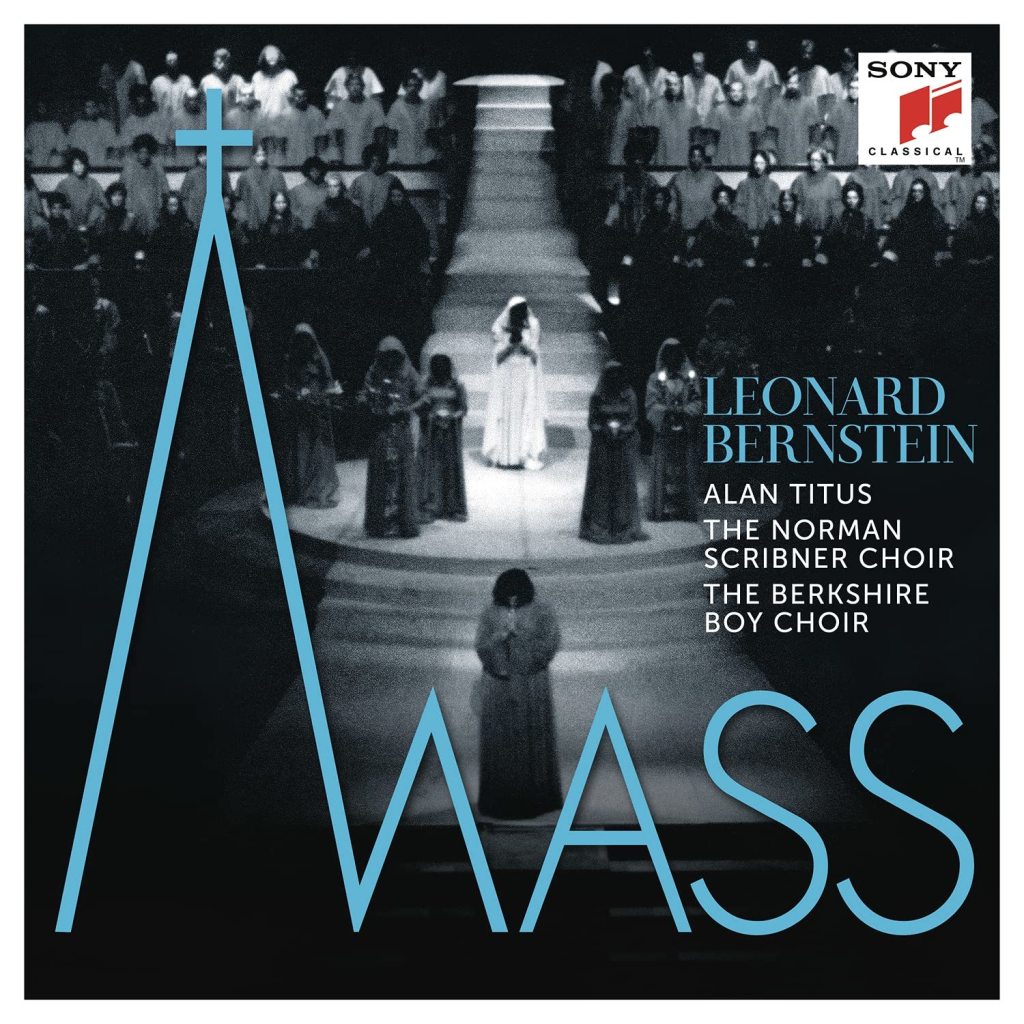
Leonard Bernstein’s MASS: A Theatre Piece for Singers, Players and Dancers (1971 Original Kennedy Center Cast Recording) – Part 1


This post concerns Disc 1 only.

Bernstein’s Mass can seem intimidating to a newcomer. I know I certainly was when I was young. Mass exists on the fringe of musical theatre genre. It is musical theater in a literal sense but it’s subgenre or main concept is certainly outside of the traditional stage productions box. Bernstein has a way of writing music that draws me in a little at first. Then after the melody sticks to my skin after a first listens, I am drawn even closer, and the musical magnifying glass starts zooming in on new things. This piece of music is so unique and profound that I genuinely believe that each new time I listen I will learn something new about myself. If that doesn’t make sense, that’s okay. My understanding is that Bernstein’s Mass was supposed to tap into the religious part of the listeners brain that asks the big questions. I think that this is what Jackie Kennedy had in mind when she commissioned this piece. I will not to pretend to understand this piece of music in its entirety or original sense, but I can bring a fresh perspective of it. Having gone mostly unlisten-ed to for most of my life, 2021 brings us a new remastered version of the 1971 original cast recording. As I grow older my ear becomes more attuned to higher quality records and I am able to feel and experience the difference that the remastered recording has to offer.

I Devotions before Mass – II First Introit – III Second Introit – IV Confession 1, 2 , 3

“A Simple Song” is the first song (in a slightly more traditional sense) that we hear after a somewhat chaotic opening number. Bernstein makes an important point the land the audience safely onto the message at the beginning. Simple Song’s melody is haunting, unpredictable, and at very least incredibly beautiful. The orchestrations are soft and back-drawn over the simple strumming of a guitar. After the song is introduced and the vocalist, Alan Titus, sings a few lines:

Sing God a simple song: Lauda, Laude…
Make it up as you go along: Lauda, Laude…
Sing like you like to sing. God loves all simple things,
For God is the simplest of all


Ascending and descending plucked guitar motifs bring us into the heart of the song. The dynamics increase and more instrumental types are brought in throughout the rest of the track. The song has a stripped down (which develops over time) style and seemingly dedication to reflect the simplicity of God.

Bernstein does not let our ears rest for very long, however, as Prefatory Prayers has a marching band give-me-an-old-trombone before-the-parade-passes-by vibe. The volume is big and the percussion is no holds barred. “In nomine Patris” starts with in the name of the Father, Son, and Holy Ghost and jumps into a galloping 5/4 beat. I’m certain that Andrew Lloyd Webber took this track as inspiration for his Hosanna from Requiem. Bernstein commits to a bouncing tambourine for the entire In nomine track.

The next couple sections showcase the Mass’s diverse musical offerings. Elements of Jazz, Classical, Pop, Bernstein’s unique touch, and some finger-snapping bring us to a small gem: the Trope “I Don’t Know.” Bernstein evokes a sense of confusion from the listener using rapid-fire brass phrases and literal lyrics. This short number is followed by the more traditionally bluesy song “Easy.” At the end of “Easy” the preceding “I Don’t Know” themes are revisited and Titus says: Let Us Pray.

A Simple Song


V Meditation No 1 – VI Gloria 1,2,3,4 – VII Meditation no 2 VIII Epistle

The first Meditation brings an extended rest for the vocalists who are likely out of breath. At least, I am out of breath just listening to this piece. Although, by the time the Gloria section comes, my interest levels are high and I am eager to dip deeper and deeper into this tambourines-forever bring-me-closer-to-God conceptual work. The Gloria section does not disappoint in the least. Similar to the In nomine Patris from section II, this section has a driving beat with timpanis and tambourines galore. Also, a now revitalized and refreshed chorus gives us BIG energy. Holy Cow.

My favorite bit is the “Half of the People” section when, all of a sudden, the chorus is chanting radically in English and not Latin. The Rhapsody-in-Blue-jazzy-bouncey-slidey game the orchestra plays is delicious. It makes me just want to get up, raise my hands, and channel Alvin Ailey / Jesus through dance.

Amen! Half of the people are stoned!
And the other half are waiting for the next election!
Half the people are drowned!
And the other half are swimming in the wrong direction.
They call it glorious living and, baby, where does that leave you?
You and your kind

Trope: Half of the People Are Stoned


The first half of Bernstein’s Mass has enough enticing and delectable offerings that, as a listener, I certainly want more. Or rather, I am curious to see where this piece of music can go in the second half. Bernstein’s works are among the most original, authentic, and moving pieces in theater. Mass is no exception to this and I imagine JFK would have enjoyed it.
KPOP – “This Is My Korea” (2022 Original Broadway Cast)

The bubbly efflorescence of electro-pop sounds leads into the 5-way harmonies of the female leads in KPOP. The song is admittedly catchy on the first listen. Sung in Korenglish, songwriters Vernon and Park take the listener on a whirlwind of KPOP melodies and trendy dance beats. The result is a beautiful bubble gum single that promotes the new Broadway show KPOP. What is this song about? I have no idea. Do I care? Not at all! I find myself humming this to myself, unaware of what I am saying, mesmerized, hypnotized, and delighted. The song is not perfect, as some of the vocal syncopation in the verses feels clunky and rushed (possibly as it’s a condensed version?), but the overall feeling of joy and euphoria that results from listening more than makes up for these imperfections.

To say the least, I’m looking forward to the final cast recording! It’s very exciting to see Broadway welcoming non-English books/librettos to the stage. Hopefully this show opens the door for more international representation in the industry.

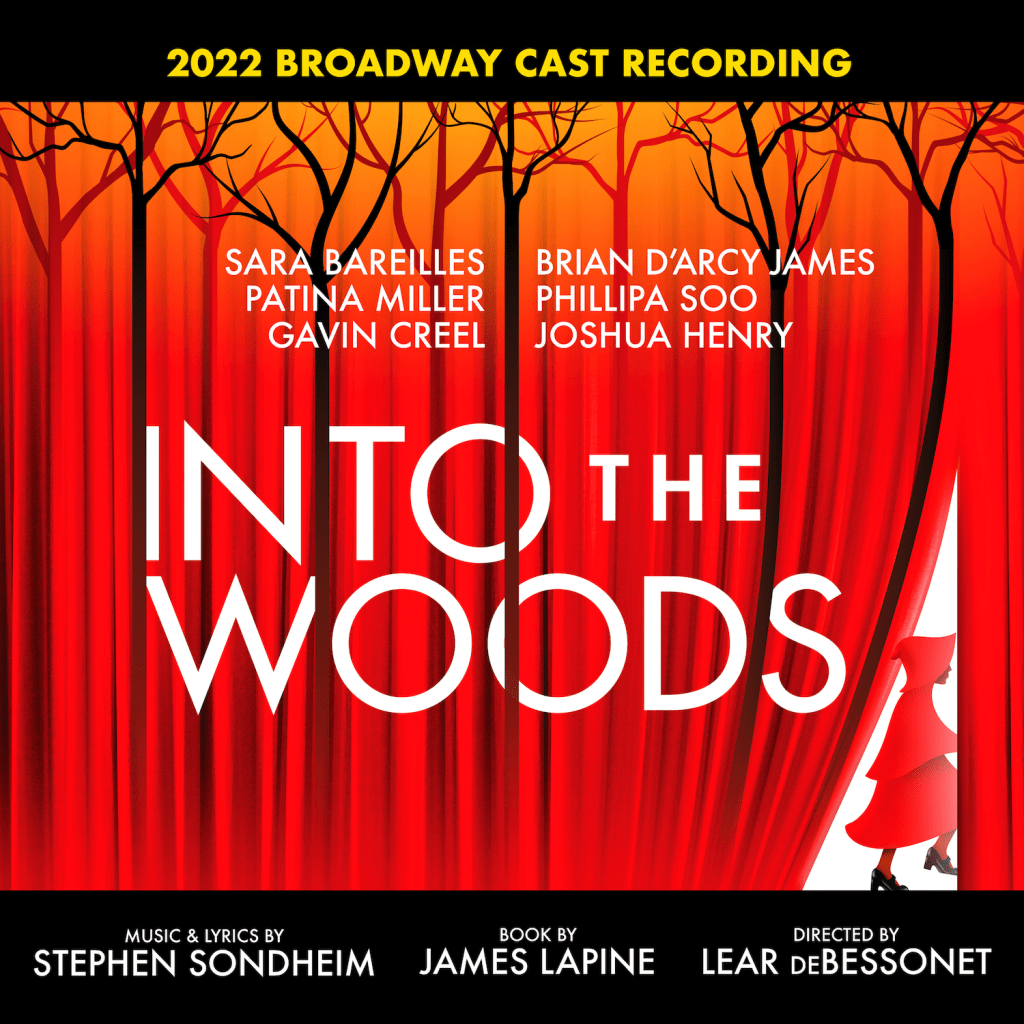
Into the Woods (2022 Broadway Revival Cast Recording)

(Thank you to all you who have reached out to me over the last year. I hope to get this blog back up and running soon! There are almost 20 unfinished posts siting in my drafts folder!)

Sondheim’s intricate, gay, and sometimes confusing score comes to life after 20 absent years from Broadway. With an All-Star cast and the complete (I think?) 14 minute Prologue, the album brings to life some nuances and moments that are absent from previous revivals/recordings.

Phillipa Soo, Sara Bareilles and Patina Miller hold down the roles of Cinderella, Baker’s Wife and the Witch. Bareilles entered the Broadway scene in a lateral move from Composer (Waitress 2015) to Actress (Waitress 2015, Jesus Christ Superstar 2018). Bareilles’ talent and acting skills are of top quality and she channels a bit of Joanna Gleason from the original Broadway cast. Her background is not in Sondheim musicals and as such she might not seem like an obvious casting choice. She brings velvety and pitch perfect tone to the role’s more melodic moments (listen to Children Will Listen). However, it is noticeable that she wavers slightly on note placement during some more complicated vocals runs (It Takes Two, Any Moment). In my opinion her take on the role adds a fresh, almost outsider, take and her lack of experience in Sondheim music does not detract from the quality of the performance.

Soo is perfection and I have nothing further to say about her. Soo as Cinderella is probably the best casting choice of the decade and it’s SUCH a gem to have the Prologue in it’s entirety with Soo singing the opening. Very nice.

Patina Miller is not a bad casting choice, but her dedication to the original vocalization of the Witch faulters, especially in Act II. Instead of letting the flow of Sondheim’s esoteric melodies lead her, it feels like she is being held back by their complexities. Like she wants to jump around and sing notes that were never meant to be improvised. The middle section of Last Midnight does not feel articulated in a precise way that I expect on a studio recording of a Sondheim score and, at times, I feel as if Miller is yelling at me. Or scolding me. The song seems to overpower her. Maybe that was the director’s decision. But relistening to Peters and Streep sing it I assume that Sondheim envisioned a little more control for the piece. Not sure. Miller is definitely a vocal powerhouse and there’s no denying her talent. Perhaps I need to open my mind to a different interpretation of the role.

This production marks one of the first major productions of a Sondheim musical following the composer’s death. Studio recordings of Sondheim musicals provide the audience with an uninterrupted and unobscured view into the madness of Sondheim’s musicality. As we continue to mourn his death, we look forward to future generations interpretations of his works. This album marks just the beginning of that journey.

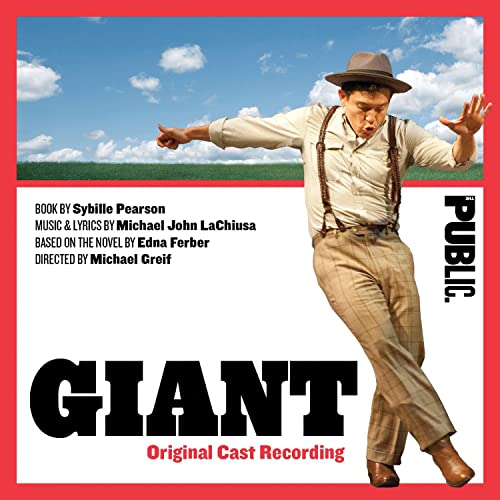
Giant (2013 Original Off-Broadway Cast Recording)

flac

Michael John LaChiusa is an interesting composer. Despite being disliked by many, there is something about his style that is endearing enough to be produced as often as he is. What that something is is hard to say. But I think Giant puts me one step closer to understanding what people find so intriguing about him.

LaChiusa’s song structure is loose and less committed to time and space, in a sense, than other prolific American composers. It reminds me a bit of Jason Robert Brown’s Parade, using a piano and orchestra with soaring melodies to drive the spirit of the American south along the road. Although I would put JRB’s music in the “committed to time and space” category, with his [JRB] song structures being more patterned in organization organized. I wonder if LaChiusa can be interpreted as being second generation to Sondheim’s American Musical Theater takeover in the 1970s/1980s. I dislike comparing others to Sondheim, but his legacy and influence is hard to avoid in contemporary musical theater. Either way, LaChiusa holds his own and tackles a huge book of a musical.

The show opens with a tribute to the Mexican culture embedded into the world of the American south: Aurelia Dolores. This song, musically, misleads us with it’s guitar, lack of piano, Spanish lyrics, and well-structured verses. This glorious 3/4 melody will be revisited in the Act II finale (rightly so) and acts as a musical anchor that feels much more structured than the songs that make up the majority of the score. I find this song to be an interesting choice for an opening number when I compare Giant to other LaChiusa scores. This number grows on me more and more each time I give it a listen.

Did Spring Come To Texas and Your Texas introduce our featured actors: Brian D’Arcy James and Kate Baldwin. D’Arcy James’ voice has aged incredibly well since I first was introduced to him in Yeston’s 1997 OBCR of Titanic. D’Arcy James’ broad voice compliments LaChiusa’s introduction of the wide reaching piano themes. In the song Your Texas, Balwin foreshadows the long-life that she wishes to live. We experience more typically LaChiusa melodies in these numbers.

Heartbreak Country was the first song that I repeated when I first listened to this album. I needed to hear the melody of the chorus again. This is the most 4/4-verse-chorus-bridge-chorus-etc so far (less than the opening number, though) and while the verses have plenty of wonder in themselves, its the chorus and its the rolling orchestrations that is most addictive. The “heartbreak country, cruel and violent…” motif takes the listener soaring threw the big sky of LaChiusa’s musical world. This chorus is heart warmingly catchy and I have a hard time getting it out of my head after listening to it. The bridge takes us on a rowdy adventure through the (literal) wilderness and farm country of Texas. It builds and builds with LaChiusa focusing attention on the quarter note downbeats of the rhythm. The Chorus unfolds again, this time with a key change. This song is an amazing counter-example to much of the critique that LaChiusa receives regarding his compositional structure.


Look Back / Look Ahead is a standout track for me. The line Remember what I said… rings hauntingly in my ears when sung by the chorus. This song showcases LaChiusa’s unique way of weaving melodic dialogue with carefully crafted lush choral and orchestral arrangements. LaChiusa’s use of trumpets gives the song a triumphant, anthemic feel.

Close to the end of the first act, we reach a song called When To Bluff. This song introduces a marked change in musicality, likely due to a change in story/scenery, we meet some new voices and the song has a driving jazzy snare drum that is reminiscent of a jazz club in a nearby big city. From this point forward listening to the album, I look forward to what new adventures await as each track passes. LaChiusa has introduced a full range of musical themes that allow the actors to freely portray their characters in a way that feels natural. Natural, and beautiful.

When act one comes to a finish, I am filled with curiosity and a desire to explore the landscape and culture of Texas. The act one finale is a short number that reprises the heartbreak country theme while overlapping a monologue with choral responses.

Act two begins with the introduction of a new musical theme (Our Mornings) while maintaining the familiar orchestrations found in act one. The (act two) opening number is significantly longer than any track we’ve heard thus far and LaChiusa’s stream-of-consciousness musical stylings come into play.

The second act also introduces a number of new characters. The source material for this musical is a novel by Edna Ferber (she also wrote Show Boat(!!!)) which takes place over 30 years and has a million characters. The large scale of this musical’s book seems too big for an off-Broadway production and is accommodated by an original running time of (almost) 4 hours in 3 acts. The album cuts the show down to 2+ hours in 2 acts (I’m not sure where the third act went, but the last track is titled Act 2 Finale)….)

Un Beso, Beso is a standout track for me in Act II. Firstly, it reminds me of my (hispanic) grandparents/relatives demanding kisses (besos) from me as a kid. The song enjoys a bouncy and catchy 5/8 chorus that celebrates Mexican-American culture. LaChiusa’s loose structure continues through the second act. Look Ahead is reprised briefly, much to my delight, in the track Place in the World.


I will admit that with the introduction of new characters and new storylines as the musical unfolds, the tracks start to feel slightly less connected and almost disjointed from one another. I suppose it might make more sense in the context of the stage production, but as a listener (and only a listener) I start to feel a tiny bit lost on the first listen. One example of this disjointedness is the track Midnight Blues in which the second half of the song we are reintroduced to some Kate Baldwin-Texas-themes but it’s harder to digest when contrasted with more city-blues than Texas-country.

At the end of the album, we are reunited with Aurelia Dolores, but this time a new generation of characters is telling the story. This musical theme is only evident in the opening number and closing number and it is so glorious. Our favorite heartbreak country is briefly reprised prior to the grand-finale. Overall Giant is a great listen. If you are unfamiliar with Lachiusa’s work, Giant might be a great place to start.


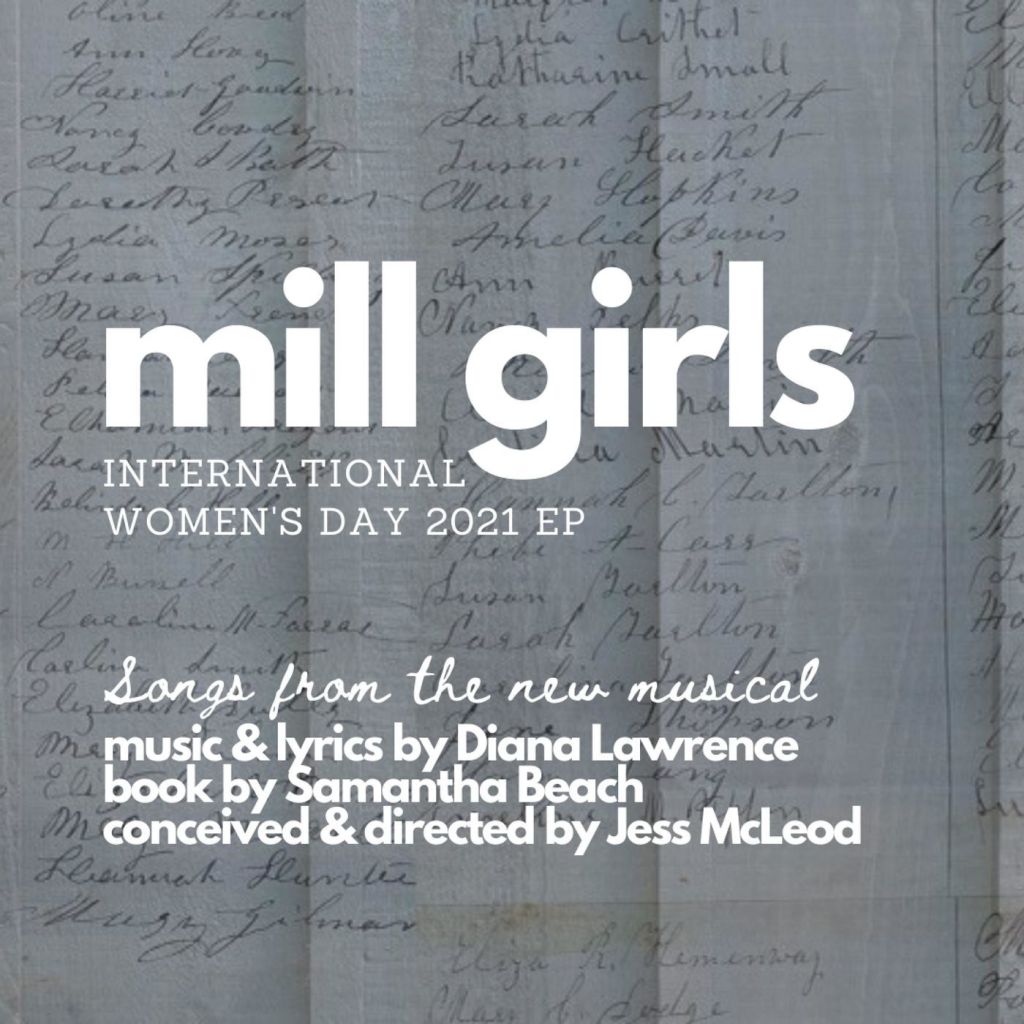
Mill Girls (2021 Studio Cast Recording) International Women’s Day 2021 EP

This tiny EP is the first recording of Diana Lawrence’s newly conceived Mill Girls. This 8 track EP is 3-4 songs, interwoven with small interludes that showcase the show’s book. As I’ve mentioned before, it’s an interesting year for new theatre music. The creative pressure built up from the covid lockdown will be relieved soon when theaters around the world re-open. And a years+ worth of unrealized projects will have an opportunity for being produced.

The song Why We Rise has a bouncy folk style intro that sounds an awful lot like Sondheim’s “Ballad of Booth” from Assassins. There are some slightly unrefined vocals/balance which raise a small red flag in my analysis. But the song’s chorus is a catchy hand-clapping fiddle folk ditty, with alternating verses that counter the feel of the chorus, with mellow piano, slower tempo, story driven singalogue, etc. The verses are intriguing enough to want a little more. And we return to the catchy chorus (cue fiddle and hand-clapping) a few times until eventually the final chorus is delivered as a 3 part canon, which is always a win for me, and we get a moment to bask in the overlapping 3 dimensional waves of the chorus. And finally, an 5+ way harmony final sustained chord to end the song. Despite the rocky intro, the song develops into a great motivational folk anthem. My positive attitude toward the song propels me through the rest of the EP with ease.

The song What is a Day For is a nice enough ensemble number. The build up to the song’s finale features overlapping spoken dialogue with singalogue to an interesting degree, more or less. Overall, the EP is a good listen, although there are some production, recording, and mixing issues that are most likely a cause of Covid restrictions for recording artists. The final number was unmemorable for me, although the ending pulls the song together nicely. I think the the final track was a poor choice for an EP, as the ending drops off suddenly and there’s no closure that brings the overarching musical themes of the show together.

Let’s wait and see if Lawrence’s Mill Girls moves to the next step of production realization.

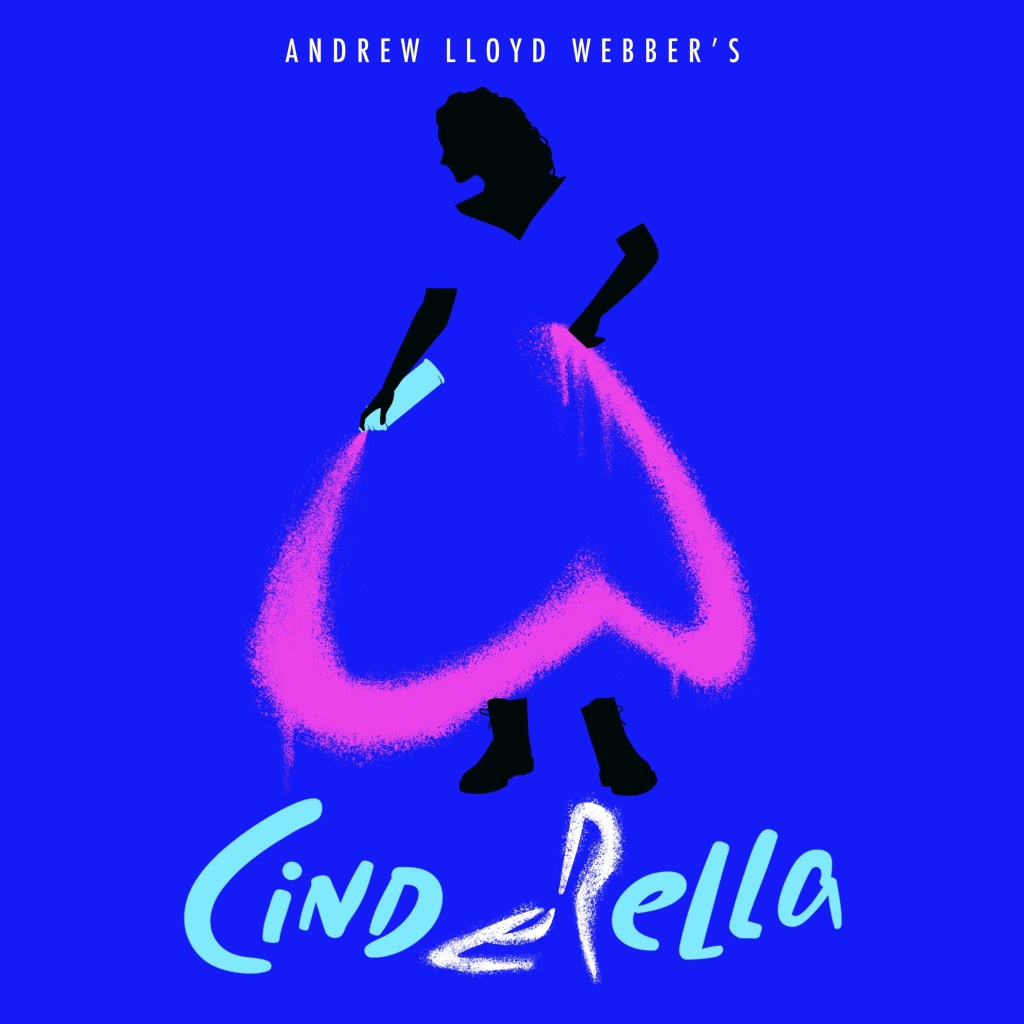
Andrew Lloyd Webber’s Cinderella (2021 Original London Cast Recording)

320kbps mp3

Somewhere in the mid-90s, Andrew Lloyd Webber changed direction, musically. I usually split and categorize his shows as either from 1968(?)-1993 and 1998-Present or, his first quarter-century work and his second quarter-century work. I was less interested in the project, thinking, another Cinderella story? There are so many! Looking into it a bit, I decided to give the album a listen. Lloyd Webber, to my delight, decided to release a full 2-CD recording that includes (most of the) London cast. On my first listen, I noticed something unusual: this doesn’t sound like his recent work at all. Stephen Ward? Woman in White? Beautiful Game? Love Never Dies? Nothing of the sort!

Lloyd Webber dives right in with an 8-Minute opening number that introduces several themes and is intriguing enough. In the intro, after the title “Bad Cinderella” theme, ALW starts channeling Lionel Bart’s Who Will Buy. David Zippel’s whimsical Buns ‘n’ Roses lyrics sound natural, humorous, and modern. ALW mirrors this humor and modern style with big choral harmonies, trumpet fanfare for days and days and days, and a real departure from his Victorian obsessed style we’ve all grown accustomed to. Sarah Brightman, in her 5th appearance in an ALW album (after Cats, Song & Dance, Requiem, and, of course, Phantom of the Opera), makes a cameo during the opening number, much to my surprise.

The “title” track “Bad Cinderella” is a strong second number. It meets my ALW standard for power ballads. And the interlude between it and the intro (“It Has To Be Her”) tickles my musical funny bone.

One highlight for me is the dizzying-harpsichord-with-no-time-signature track “Unfair.” After the sisters go at it for a couple minutes (Zippel’s writing really shines here), Victoria Hamilton-Barritt delivers a stand-out, disturbingly wonderful solo in the second half of the track. I especially enjoy when she transitions to the “bad cinderella” theme near the end, then the bongos enter, and the step-mother goes on a psychopathic rant and you can hear her spitting out her poisonous vocals, the tempo increases, there’s a key change, the sisters join in, and the song finishes. Hamilton-Barritt’s diction/delivery is to die for.

Unbreakable is Cinderella’s second solo. ALW channels his Joseph-and-the-Amazing-Technicolor-Dreamcoat-Close-Every-Door-On-Me-Vibes, and Carrie Hope Fletcher holds her ground as a force to be reckoned with on the West End.

Act 1 ends(? I assume?) with a slightly drawn out number called Beauty has a Price. The track is decent enough. ALW does this thing where sometimes the melody vocals are echoed note-for-note by a synthesizer and the song becomes very linear feeling.

Act 2 opens with a long waltz/ball scene. Fletcher sings her solo I Know I Have a Heart. A decent power ballad with a weird structure in the chorus. The chord progression doesn’t feel very natural. Almost like a computer program wrote it. I don’t know. This aural discomfort continues through the Act 2 Scene 2 bit and I Am No Longer Me.

I know I have a heart because you broke it is a bit cheesy, isn’t it?

Moment of Triumph re-captivates me. Hamilton-Barret swoops in and saves the score of Act 2. The song turns into a nice trio(?) (quartet?) with overlapping wails from the sisters.

As is expected for an ALW act two, many of the songs are reprises or variations on the Act One pop ballads. However, The Vanquishing of the Three Headed Sea Witch is a nice and quite bizarre melody with a driving minor tune. Similar energy as Beauty Underneath from Love Never Dies. Near the end it drags on a bit when he sings a long percussion-less bridge. The track has a fun and novel melody, exciting energy, and a crazy ending last note that I could never sing in a million years.

The show ends with a cute gay twist. And Fletcher performs a lovely reprise of I Know I Have a Heart in Cinderella’s Soliloquy. The Wedding Party is surprisingly modern for ALW. The percussion section offers us a rich collection of latin and hip-hop beats. This number is a nice segue to the finale. The finale starts with a creepy slow xylophone solo of Unbreakable and we learn that Cinderella has disappeared. Ivano Turco reprises Only You, Lonley You, and Cinderalla returns unexpectedly, the two of them reconcile and an underlying clarinet(sax?) leads us to the end with a cute short dialogue between the two leads.

I’ll admit the very last moments of the album are a bit lackluster. But, like Phantom of the Opera’s ending, it’s much better (and makes more sense) when you see it in a theatre. All in all, though, this is a really great score and it ranks very high compared to his last couple decades of works. I am happy that ALW has contributed a version of Cinderella to the world of theatre.

We live in a world where ALW and Sondheim are still writing musicals. Take a moment and soak it in. ALW should be proud of this album and I think it’s one of the top cast recordings from the last year or two.


Diana (2021 Original Broadway Cast Recording)

320 MP3

The anticipation of this album release has been very real for me for more than a year now. I was so excited to listen to this back in 2020, and for obvious reasons it got postponed, and I was left with only the “If” music video to scratch my Diana itch. I did not set any expectations for this production as I am not familiar with David Bryan’s works: Memphis, Toxic Avenger.

First I’d like to note that we’ve finally arrived to new Original Broadway Cast Recordings, and my heart couldn’t be happier. Despite my distaste for a few tracks, I think this is a lovely album overall. It’s a challenge to make a musical biography not look like a parody. Diana is painted in a good light, despite the shortcomings of the score.

But! The album is not great in some moments. Here are some low points for me:

As I Love You – Te Amo? Te quiero? – his song makes me very uncomfortable, which might be the emotion they’re trying to evoke(?), but man, it’s a rough listen. It’s 2 minutes of cringe that is hard for me to sit through. The keyboard synth and her voice breaks and the lack of melody. It’s all terrible.

I Will – This song falls flat from square one. The lyrics do not help save this melody. The first verses are fine enough, but then… “I will make him love me” with the MARACAS oh gosh it’s terrible. The lyrics and melody “I will… I will… I will…” is not interesting or unpredictable. The bridge builds a bit of intrigue. Then the chorus enters. “I will… I will…” It builds a bit, softens, many extra syllables are thrown in until the very end. I’m left not wanting more after the very last:

IIIIIIIIII WIIIIIIIIILLLLLLLL.

The Dress – My biggest complaint is the percussion section only drums on the down beat 1-2-1-2-1-2-1-2 and then there’s this higher pitched “fuckity-fuckity-fuckity.” This song is a mess to listen to.

Officer’s Wife – Again with the percussion. It’s so boring. Like, I get it, it’s regal, but the whooole song… The chorus swings in near the end of the song to try to save it but fails to do so.

Snap Click – Chess did this better with Press Conference. Worth pointing out the delicious percussion section around 2:45:

versus:


Not to worry! The album has plenty of highlights:

World Fell In Love – An exciting song, big horns, big choral bits. Pretty good representation of what Bryan’s score sounds like.


Pretty Pretty Girl – Great melody. This song stands out to me.
Hidden gem is the 40 sec Pretty Pretty Girl reprise before Words Came Pouring… and speaking of…

Words Came Pouring Out – Fun track. Decent follow up to Pretty Girl, which I consider a major highlight of this album. The tune is catchy when you are listening, but it doesn’t stick for very long. Not bad though and the chorus does a great job in this number.

Him and Her / Just Dance – What a beautiful track. I think the lyrics are super corny and not very creative in the first half of this track. But it’s such a lovely melody. If you can hold out through the first couple minutes, this song flourishes into a gorgeous quartet(?)+chorus. Bryan transitions every 30 seconds with key change but each time this happens another harmony is added when the chorus joins. But when Just Dance… starts, I can’t help but close my eyes and sway back and forth with my arms extended like a hippy at a festival. The Just Dance part has plenty of key changes, it’s a bit impressive how often he does this. Laurence O’Keefe is revoked of his how-many-key-changes-you-can-fit-in-a-song crown. This is one of my favorite tracks.


The Main Event – What a great ensemble number. Reminds me of a poppier version of certain songs from Chess. With the call and response with the press, etc. Near the end, I will be honest, of the song I just got up and started dancing.

If – At the end we are met with If (Light of the World.) The song ends abruptly and loudly and is followed by a quick outro that is a bit lackluster and short. But the song itself is fantastic.

I’ve listened to it thrice, and I enjoyed enough to guarantee that I’ll listen to it again soon. Diana is certainly original score. In a changing theater market, Diana is one of the first new original productions to test the post-covid audience. It will be interesting how the Netflix special and the re-opening on Broadway will fair for the show. We will see soon!

I remember the day she died. I know she loved the theater and in another dimension where Diana is alive, she would likely appreciate Jeanna De Waal’s graceful portrayal of her.


Edit: After many, many more listens, I can confirm that my favorite tracks are: Him and Her/Just Dance, Main Event, Words Came Pouring Out(!). Runners up are Pretty Girl, If. Also, the fact that this music reminds me of Chess is a compliment to the shows dedication to 1980 UK vibes.

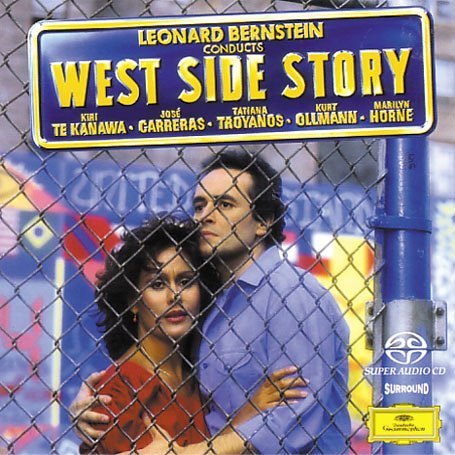
West Side Story (1985 Studio Cast Recording) Cond. Leonard Bernstein

I had to triple check to make sure that I hadn’t already written about this album recently, as it’s easily a top 10 for me (I should actually make a list, as I find myself saying that a lot). The album is a studio (non-stage production) recording and it uses color-blind casting focused on opera heavy-hitters. Kiki Te Kanawa, of Maori decent, as Maria. Joel Carreras, of Spanish decent, as Tony. And Tatiana Troyanos, of German/Greek decent as Anita. Bernstein himself conducts this recording. And I believe this is the first (and only?) recording (of West Side Story) with Bernstein conducting. I could be mistaken. But with regard to the change in medium, Bernstein is no stranger to opera. In fact, he has written more opera/operettas than broadway musicals (I think?). Candide and Trouble in Tahiti are the first one’s to come to my mind.

The Dance at the Gym numbers remain timeless in their melodies and rhythm. Bernstein goes HAM on the Mambo and it’s hard to stay sitting in my chair at this coffee shop while listening. It is so high energy and emotional. You can feel bernstein’s energy and sweat dripping into the music itself. It’s a really great recording of the Dance.

The tracks America and Cool are highlights for me as well. In America, especially, Bernstein’s use of acoustic guitar and a diverse percussion and horn section brings this iconic Puerto Rican anthem to life in a very big and bright way.

West Side Story is likely Bernstein’s most famous piece of music. And as a huge fan of his opera/operetta work, as well as his symphonic/choral work, and his symphonic variations of the score of West Side Story, it is quite lovely to hear this score from a operatic perspective. Listening to this album reminds me how timeless the West Side Story score is. It sounds modern, bright, and relevant in any decade and in most forms of media (opera, broadway, film…) This recording was made 5 years prior to his death in 1990. It is such a blessing to have this recording and hear Bernstein’s interpretation of his own score 25+ years after the show opened.

Bernstein’s music will live on forever. I’m sure many would consider West Side Story to be his magnum opus. I won’t agree or disagree, but rather, acknowledge it’s outstanding timelessness and it’s ability to reach out to every type of audience and move them emotionally.

Mulan II (2004 Film Soundtrack)

320

Okay wait! Before you dismiss a direct-to-video disney release, hear me out! Jeanine Tesori, composer of Fun Home / Shrek / Thouroughly Modern Millie / Caroline or Change, working with Lea Salonga(!), Judy Kuhn(!), and Hayley Westerna, with the moderate-to-high-quality disney production value. The album itself is okay, but it has 3 tracks that are worth listening to. These small gems are tucked away in the niche music catalog of direct-to-video film soundtracks. The lyrics are certainly indicative of a children’s film, but the melodies are complex, captivating and, at moments, soaringly beautiful. The music itself listens to like a broad, beautiful, landscape painting, with wide reaching musical architecture and smart and deliberate structure.

(1) Track #1 Lesson Number One. “Earth. Sky. Day. Night.” The intro draws you in fairly quickly and the first verse sets a pretty high bar in terms of captivating melodies. The architecture of the song is theatrical and keeps you on the edge of your listening seat. Structurally, there’s a high velocity feel moving toward the bridges and there are plenty of key changes to keep one engaged. The bridge and chorus meet the verses in quality level. The ending has a nice canon between the children and adults with equally nice harmonies sung by Salonga.

(2) Track #3 Like Other Girls.

This number is decent. There is some awkward and questionable asian-mocking-asian accents situation going on at one point, which serves as a distraction from the actual music, and dates this album quite a bit, but Judy Kuhn singing Jeanine Teori is worth listening to.

(3) Track #5 Here Beside Me

And then suddenly… an unexpected opera aria? Clear out of left field, classical crossover singer Hayley Westenra sings an intense, melodic, soaring-through-the-clouds, beautiful number. This song showcases Tesori’s ability to write music that hits the heart directly.

I wouldn’t consider this album to be essential in a collection. But for fans of Tesori’s work, fans of Disney productions, and/or fans of Salonga/Kuhn, this album, especially the latter of the songs listed above, is 100% worth listening to.

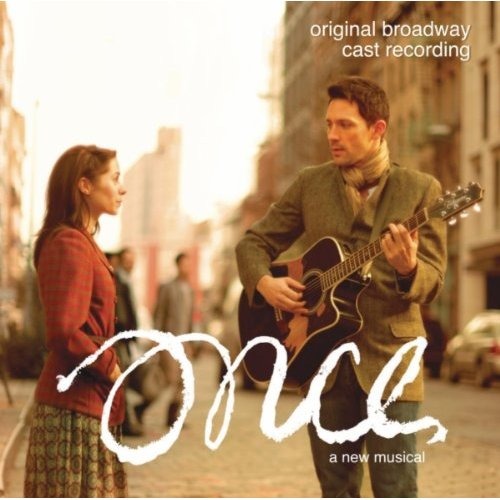
Once (2012 Original Broadway Cast Recording)

m4a vbr + dig booklet

This is (one of) my mother’s favorite musical. Years ago, on her birthday, we were out for dinner as a family. There was a singer with a guitar providing entertainment and he was taking requests. My mom requested Falling Slowly but she couldn’t remember the title of the song, so she just said “that one song from Once.” Once, both the movie and the musical, flew over my radar whenever they came out. I had no idea what my mother was talking about, but to my surprise, and future delight, the singer knew the track she was talking about and performed a lovely rendition.

Falling Slowly needs absolutely no explanation. The song is breathtaking. In the Broadway recording, Cristin Milioti matches [the movie actresses name] in energy, and Steve Kazee takes a much softer approach to the role, compared to his movie counterpart. The guitar intro is replaced with a piano which removes any edge the song ever had to begin with. The result is an almost perfect duet between Kazee and Milioti, floating seamlessly through the air.

I don’t know you
but I want you
all the more for that
words fall through me
always fool me
and I can’t react


This album is a staple in anyone’s Broadway collection. One of the best (and one of my favorites) in the Actor-Musician genre. It was one of the first big non-Doyle Actor-Musician Broadway successes. Once deservingly won the 2012 Tony. I’m unsure as to why it was not eligable / did not get nominated for original Score, when Newsies, which is also from a movie, won. I’m not sure why Once wasn’t recognized for it’s score. It did, however, win 8 awards that year, including Orchestrations, Leading Actor, Book, and Sound Design.

Other album highlights include: Leave, Gold, The Hill, and When Your Mind’s Made Up. But the entire album drinks like a smooth glass of wine. Everything leads up to the finale: an acapella version of Gold that sends chills down any humans spine, followed by a reprise of Falling Slowly that tops the original movie and original non-reprise Broadway version. Nearing perfection, this album will pull at your heartstrings and increase your dopamine levels. This album has become one of my favorite OBCRs, and it gets better each additional time I hear it.

Gold A Capella