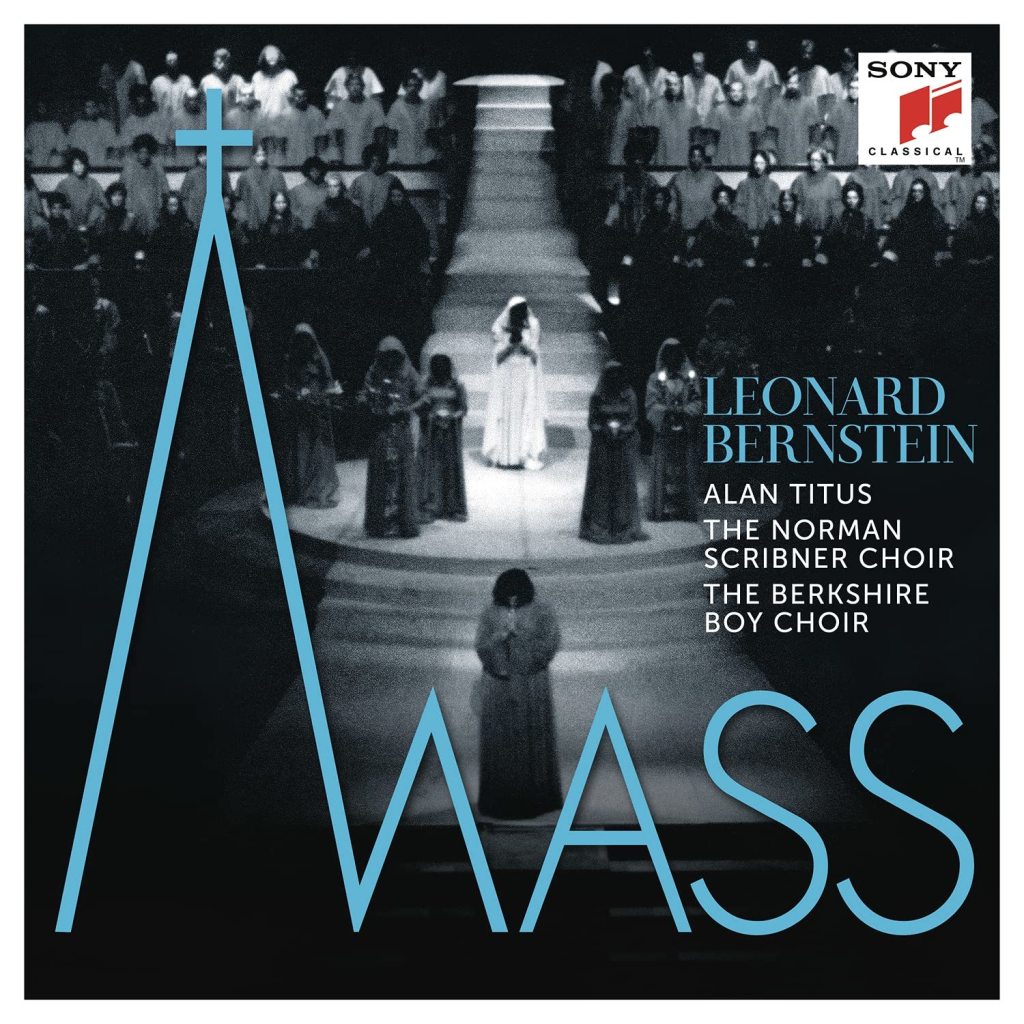
This post concerns Disc 1 only.
Bernstein’s Mass can seem intimidating to a newcomer. I know I certainly was when I was young. Mass exists on the fringe of musical theatre genre. It is musical theater in a literal sense but it’s subgenre or main concept is certainly outside of the traditional stage productions box. Bernstein has a way of writing music that draws me in a little at first. Then after the melody sticks to my skin after a first listens, I am drawn even closer, and the musical magnifying glass starts zooming in on new things. This piece of music is so unique and profound that I genuinely believe that each new time I listen I will learn something new about myself. If that doesn’t make sense, that’s okay. My understanding is that Bernstein’s Mass was supposed to tap into the religious part of the listeners brain that asks the big questions. I think that this is what Jackie Kennedy had in mind when she commissioned this piece. I will not to pretend to understand this piece of music in its entirety or original sense, but I can bring a fresh perspective of it. Having gone mostly unlisten-ed to for most of my life, 2021 brings us a new remastered version of the 1971 original cast recording. As I grow older my ear becomes more attuned to higher quality records and I am able to feel and experience the difference that the remastered recording has to offer.
I Devotions before Mass – II First Introit – III Second Introit – IV Confession 1, 2 , 3
“A Simple Song” is the first song (in a slightly more traditional sense) that we hear after a somewhat chaotic opening number. Bernstein makes an important point the land the audience safely onto the message at the beginning. Simple Song’s melody is haunting, unpredictable, and at very least incredibly beautiful. The orchestrations are soft and back-drawn over the simple strumming of a guitar. After the song is introduced and the vocalist, Alan Titus, sings a few lines:
Sing God a simple song: Lauda, Laude…
Make it up as you go along: Lauda, Laude…
Sing like you like to sing. God loves all simple things,
For God is the simplest of all…
Ascending and descending plucked guitar motifs bring us into the heart of the song. The dynamics increase and more instrumental types are brought in throughout the rest of the track. The song has a stripped down (which develops over time) style and seemingly dedication to reflect the simplicity of God.
Bernstein does not let our ears rest for very long, however, as Prefatory Prayers has a marching band give-me-an-old-trombone before-the-parade-passes-by vibe. The volume is big and the percussion is no holds barred. “In nomine Patris” starts with in the name of the Father, Son, and Holy Ghost and jumps into a galloping 5/4 beat. I’m certain that Andrew Lloyd Webber took this track as inspiration for his Hosanna from Requiem. Bernstein commits to a bouncing tambourine for the entire In nomine track.
The next couple sections showcase the Mass’s diverse musical offerings. Elements of Jazz, Classical, Pop, Bernstein’s unique touch, and some finger-snapping bring us to a small gem: the Trope “I Don’t Know.” Bernstein evokes a sense of confusion from the listener using rapid-fire brass phrases and literal lyrics. This short number is followed by the more traditionally bluesy song “Easy.” At the end of “Easy” the preceding “I Don’t Know” themes are revisited and Titus says: Let Us Pray.
V Meditation No 1 – VI Gloria 1,2,3,4 – VII Meditation no 2 – VIII Epistle
The first Meditation brings an extended rest for the vocalists who are likely out of breath. At least, I am out of breath just listening to this piece. Although, by the time the Gloria section comes, my interest levels are high and I am eager to dip deeper and deeper into this tambourines-forever bring-me-closer-to-God conceptual work. The Gloria section does not disappoint in the least. Similar to the In nomine Patris from section II, this section has a driving beat with timpanis and tambourines galore. Also, a now revitalized and refreshed chorus gives us BIG energy. Holy Cow.
My favorite bit is the “Half of the People” section when, all of a sudden, the chorus is chanting radically in English and not Latin. The Rhapsody-in-Blue-jazzy-bouncey-slidey game the orchestra plays is delicious. It makes me just want to get up, raise my hands, and channel Alvin Ailey / Jesus through dance.
Amen! Half of the people are stoned!
And the other half are waiting for the next election!
Half the people are drowned!
And the other half are swimming in the wrong direction.
They call it glorious living and, baby, where does that leave you?
You and your kind
The first half of Bernstein’s Mass has enough enticing and delectable offerings that, as a listener, I certainly want more. Or rather, I am curious to see where this piece of music can go in the second half. Bernstein’s works are among the most original, authentic, and moving pieces in theater. Mass is no exception to this and I imagine JFK would have enjoyed it.
 100+ Years of Musicals