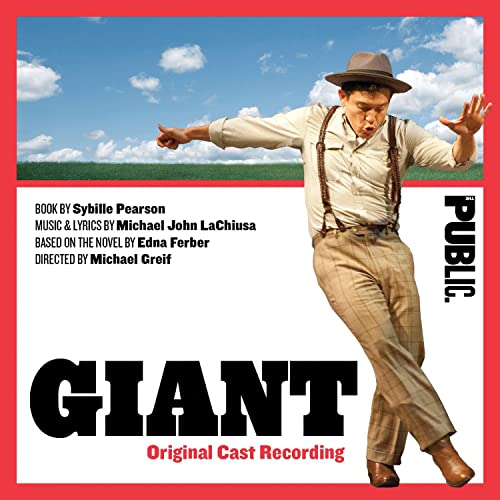
Michael John LaChiusa is an interesting composer. Despite being disliked by many, there is something about his style that is endearing enough to be produced as often as he is. What that something is is hard to say. But I think Giant puts me one step closer to understanding what people find so intriguing about him.
LaChiusa’s song structure is loose and less committed to time and space, in a sense, than other prolific American composers. It reminds me a bit of Jason Robert Brown’s Parade, using a piano and orchestra with soaring melodies to drive the spirit of the American south along the road. Although I would put JRB’s music in the “committed to time and space” category, with his [JRB] song structures being more patterned in organization organized. I wonder if LaChiusa can be interpreted as being second generation to Sondheim’s American Musical Theater takeover in the 1970s/1980s. I dislike comparing others to Sondheim, but his legacy and influence is hard to avoid in contemporary musical theater. Either way, LaChiusa holds his own and tackles a huge book of a musical.
The show opens with a tribute to the Mexican culture embedded into the world of the American south: Aurelia Dolores. This song, musically, misleads us with it’s guitar, lack of piano, Spanish lyrics, and well-structured verses. This glorious 3/4 melody will be revisited in the Act II finale (rightly so) and acts as a musical anchor that feels much more structured than the songs that make up the majority of the score. I find this song to be an interesting choice for an opening number when I compare Giant to other LaChiusa scores. This number grows on me more and more each time I give it a listen.
Did Spring Come To Texas and Your Texas introduce our featured actors: Brian D’Arcy James and Kate Baldwin. D’Arcy James’ voice has aged incredibly well since I first was introduced to him in Yeston’s 1997 OBCR of Titanic. D’Arcy James’ broad voice compliments LaChiusa’s introduction of the wide reaching piano themes. In the song Your Texas, Balwin foreshadows the long-life that she wishes to live. We experience more typically LaChiusa melodies in these numbers.
Heartbreak Country was the first song that I repeated when I first listened to this album. I needed to hear the melody of the chorus again. This is the most 4/4-verse-chorus-bridge-chorus-etc so far (less than the opening number, though) and while the verses have plenty of wonder in themselves, its the chorus and its the rolling orchestrations that is most addictive. The “heartbreak country, cruel and violent…” motif takes the listener soaring threw the big sky of LaChiusa’s musical world. This chorus is heart warmingly catchy and I have a hard time getting it out of my head after listening to it. The bridge takes us on a rowdy adventure through the (literal) wilderness and farm country of Texas. It builds and builds with LaChiusa focusing attention on the quarter note downbeats of the rhythm. The Chorus unfolds again, this time with a key change. This song is an amazing counter-example to much of the critique that LaChiusa receives regarding his compositional structure.
Look Back / Look Ahead is a standout track for me. The line Remember what I said… rings hauntingly in my ears when sung by the chorus. This song showcases LaChiusa’s unique way of weaving melodic dialogue with carefully crafted lush choral and orchestral arrangements. LaChiusa’s use of trumpets gives the song a triumphant, anthemic feel.
Close to the end of the first act, we reach a song called When To Bluff. This song introduces a marked change in musicality, likely due to a change in story/scenery, we meet some new voices and the song has a driving jazzy snare drum that is reminiscent of a jazz club in a nearby big city. From this point forward listening to the album, I look forward to what new adventures await as each track passes. LaChiusa has introduced a full range of musical themes that allow the actors to freely portray their characters in a way that feels natural. Natural, and beautiful.
When act one comes to a finish, I am filled with curiosity and a desire to explore the landscape and culture of Texas. The act one finale is a short number that reprises the heartbreak country theme while overlapping a monologue with choral responses.
Act two begins with the introduction of a new musical theme (Our Mornings) while maintaining the familiar orchestrations found in act one. The (act two) opening number is significantly longer than any track we’ve heard thus far and LaChiusa’s stream-of-consciousness musical stylings come into play.
The second act also introduces a number of new characters. The source material for this musical is a novel by Edna Ferber (she also wrote Show Boat(!!!)) which takes place over 30 years and has a million characters. The large scale of this musical’s book seems too big for an off-Broadway production and is accommodated by an original running time of (almost) 4 hours in 3 acts. The album cuts the show down to 2+ hours in 2 acts (I’m not sure where the third act went, but the last track is titled Act 2 Finale)….)
Un Beso, Beso is a standout track for me in Act II. Firstly, it reminds me of my (hispanic) grandparents/relatives demanding kisses (besos) from me as a kid. The song enjoys a bouncy and catchy 5/8 chorus that celebrates Mexican-American culture. LaChiusa’s loose structure continues through the second act. Look Ahead is reprised briefly, much to my delight, in the track Place in the World.
I will admit that with the introduction of new characters and new storylines as the musical unfolds, the tracks start to feel slightly less connected and almost disjointed from one another. I suppose it might make more sense in the context of the stage production, but as a listener (and only a listener) I start to feel a tiny bit lost on the first listen. One example of this disjointedness is the track Midnight Blues in which the second half of the song we are reintroduced to some Kate Baldwin-Texas-themes but it’s harder to digest when contrasted with more city-blues than Texas-country.
At the end of the album, we are reunited with Aurelia Dolores, but this time a new generation of characters is telling the story. This musical theme is only evident in the opening number and closing number and it is so glorious. Our favorite heartbreak country is briefly reprised prior to the grand-finale. Overall Giant is a great listen. If you are unfamiliar with Lachiusa’s work, Giant might be a great place to start.
 100+ Years of Musicals