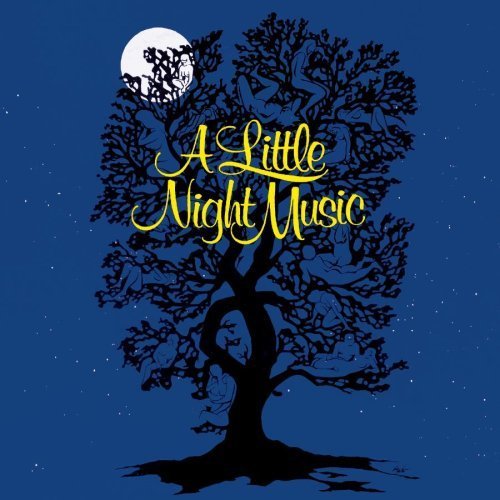
By 1973, Sondheim had already made a name for himself as master composer/lyricist, and with his two prior shows Follies and Company, he had set the bar incredibly high for himself. Needless to say, he has a magical quality of exceeding expectations.
The recording begins with a bizarre overture in which lead singers bellow operetta-esque phrases of non-sense, all in 3/4 time. In fact, with very few exceptions, Sondheim does not deviate from the time signature, although he adds variations to the theme often. Due to his creativity, and sense of musicality I suppose, the show doesn’t feel “stuck” in 3/4, and definitely has a natural ebb and flow to it. The opening solo, a personal favorite of mine, Now, begins shortly after with a quick duplet(?) phrase introducing a line only Sondheim could write:
“Now, as the sweet imbecilities tumble so lavishly onto her lap”
We are quickly thrown into the inner thoughts sung by the man, which the female character responds, though not directly, in speech. The impeccable timing of both characters is stunning, and if you close your eyes and pretend to be the composer of the song, you will likely get lost within the first 10 seconds. The juxtaposition of the manic ramblings of the man, against the almost blasé, underwhelmed tempo of the woman, makes this song an auditory treat.
Sondheim would not just leave us with Now, though. After Now comes the song Later, a slow ballad sung by a troubled young man, Henrik, in anguish at how it’s “intolerable being tolerated,” and how easy it is to feel ignored. He forcefully delivers a descending line near the end, the climax, exclaiming:
“How can I wait around for later? I’ll be ninety on my deathbed and the late, or, rather, later, Henrik Egerman.”
After the less traditional melody of Later, we are graced with the female solo Soon. Of the three melodies, Now, Later, and Soon, Soon appears the most stable and structured out of the three, and this is important because near the end of Soon, Sondheim asks all three actors to join together in a trio in which Now, Later, and Soon are all sung simultaneously, with the slower melodic proceedings of Soon acting as the glue holding everything together.
The trio of the three dissimilar melodies highlights Sondheim’s ability to craft a structured group number using the building blocks of three distinctly unique melodies, tangled together in a interwoven web of emotional disfunction, counterpoint melodies, and, of course, a triplet time signature.
The entire track is, needless to say, really well executed, and, for me, breathtaking.
Another gem on this album is the alternate take version of Glamourous Life, added as a bonus track on the album.
Most certainly a quirky and wonderful tune. I feel that it is woven together by piano/orchestral triplets and a sweeping melody. The song sounds like it would fit into modern musical theatre quite well, at least more so than some of the other tracks.
And finally, I can’t talk about A Little Night Music without mentioning Glynis Johns, with whom I was introduced to as a child via Mary Poppins. Johns delivers a stunning performance of Send in the Clowns. There has never been, and will never be, another Glynis Johns. Her voice will always bring me joy, nostalgia, and, sometimes, tears.

 100+ Years of Musicals