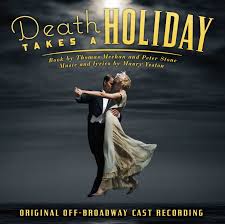
I will keep this essay short. Yeston’s scores and librettos are so crisp and clean and beautiful. Honestly I listened to this album 3 times in a row before writing this essay, and I’m mostly lost for words in it’s beauty.
With his pit pit patter of raindrops sounding first few measures of the album leading into this quiet trumpet(?) drawing you into the first vocal line “In the middle of your life.” This is classic Yeston. It’s quite apparent that Yeston writes both the score and libretto. The two blend together in a way that makes each character’s voice feel like another piece in the “Yeston Soaring and Heavenly Melodies” orchestra. This is similar in taste to his Titanic score, and in the best way possible, 14 years later. What a joy!
Like a good book, Yeston’s scores are a great example of a”page turning” style of songwriting, where each track/scene is so musically intruiging that it’s hard not to get excited to hear what comes next. Each song in Death Takes a Holiday transitions seemingly seemlessly smoothly to the next. Even though there are dialog transitions, and obvious silence between scenes, the album still feels like one long beautiful song. This style, if executed well “correctly”, works well with critics and audiences as we saw with Yeston’s Titanic, Sondheim’s Passion, ALW’s Aspects of Love.
Yeston doesn’t strench his lyrics too thin or two broadly. The connections between syllable structure and musicality/time signitures rhythm is really smooth and pleasing to the ears. You know when it feels like the lyricist tries to fit 10 syllables into half a measure? This score/libretto has none of that. There is no bumpiness or clunckiness to the words being said, and the dialog transitions seemlessly into the orchestra as new song begins.
In short, Death Takes a Holiday’s score is nothing short of gorgeous. Listen to it.
https://m e g a.nz/file/G0ohFCrJ#mJ9eplflEVpT6E2LOipzlGUvgVeq5NhuW36iGzB2Jn4
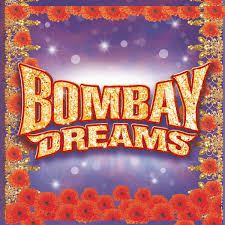
As my alarm went off at 4am this morning, I thought, why did I wake up this morning with “Chaiyya Chaiyya” stuck in my head? I’m not sure. I’ve been having a bit of writers block this week and also I’ve been on a strict Maury Yeston binge for the last week, so maybe my brain was looking something different. And different did it find.
I remember buying this CD when I was 14 years old, and I remember being extremely stoked for it’s inception ever since it was annouced. The London production ran for a respectable 2 years (is two years respectable? I suppose it is in 2020). The Broadway production stuggled to find it’s audience (literally) and only ran for 6-7 months. When the US Tour launched and made it’s way to my then home Seattle, a few of my college friends and I bought tickets as soon as we could and went out one night on an unforgettable evening.
In retrospect, Bombay Dreams was a little ahead of it’s time, maybe even being released a little too early to achieve maximum viewage. It was (as far as I know) AR Rahman’s first attempt at a West End musical, and featured an exclusive Indian cast. In the early 2000s, the only access that us white kids had to Bollywood was the random showings of Bollywood Films at a local theater. We had no Indian radio stations, no Spotify, Itunes, etc. It was definitely a genre that pushed (greatfully) the American audience into another world all together.
It’s score is clean, highly produced, electronic in the right places, acoustic in the right places, and captivating. Some songs, however, outshine other songs. All in all, it’s hard for me to stop listening to once I hear the opening Market sequence. Even through Shakalaka Baby, maybe one of the best/worst showtune of all time, I’m left wanting more.
Shakalaka baby shakalaka babythis is how it’s really meant to be | Shakalaka baby shakalaka babycome and shakalaka with me | […] No, no, no, no, no, no, no, no, no, no, no, no, no, no, no, no, no, no, no, no, no
What?
The lyrics are bizarre in some moments of the show, and occasionally make me tilt my head and squint my eyes in confusion (sorry Don Black). It’s definitely a show where the focus on the story is somewhat overshadowed by the audio/visual presentation, and while some stuck up theater critics are not fans of this, I think there is a time and place for this. AR Rahman’s 2nd West End attempt, Lord of the Rings, is a famous example of this “problem” that some shows have. But I dare anyone to come to at me and convice me that LOTR is nothing but a fantastic mind blowing musical that deserves an entire chapter in the History of Musical Theater. (Yes, I know it was a flop, but I’m not an investor or businessman, so I’ll continue my enthusiasm.)
I don’t know exactly what the show is about, having not seen it for 15 years, maybe it’s about an actor/actress making it big in Bollywood? Sounds about right. But the music transports me right back to the stage with the bright pink/red visuals, elaborate dance sequences, and undeniably soaring melodies.
The Act 1 finale that is a lukewarm reprise of a lukewarm melody with a lukewarm title “Love’s Never Easy.” Love not being easy is too obvious for me to take seriously, but don’t worry, Act 2 starts soon with the bollywood club banger “Chayya Chayya,” undeniably my favorite track in this show. 5 minutes of electric guitar and percussion driven indian dance music with a catchy chorus and with each verse a new and exciting melody. Rahman and ALW (who produced) didn’t even bother asking Don Black to translate this song, as there is no need to. The song speaks for it’s self. It says: this is party and you are going to enjoy the next 5 minutes of your life whether you understand the plot or not and also you might want to dance in a way you didn’t know you could.
Overall, the higher quality musical moments are saved for Act 2, and the Westernized pop versions are somewhat left behind in Act 1. In act 2 we see at least 4 numbers where lyricist Don Black takes the bench and AR Rahman (or his lyricist) takes center stage. The audience leaves the show both forgetting about Shakalaka Baby, but also with Shakalaka Baby stuck in their head for the rest of their lives. It’s a complicated feeling. One of ambivilance, excitement, and confusion. The show ends with a beautiful Indian Wedding (“Wedding Qawwali”).
My only complaints are as follows: Wedding Qawwali should’ve closed the show, as the following two “outro” numbers leave the OCR listener with a slightly anticlimactic ending. Also, Andrew Lloyd Webber, god bless him, plastered his name (as producter) all over this show and all of its adverts, and it’s very clear that he was not the driving creative force behind this gem. Yes, he’s famous and has money to invest, I get that, but except for hiring his friend Don Black for translations, I’m not sure he did anything at all creatively for this show. And it’s pretty akward to pretend ALW is in cohorts with the bollywood community. AR Rahman deserves all the credit for the music.
I’ll leave you with the original version of Chaiyya Chaiyya from the 1998 film “Dil Se.” Good luck not dancing.
This post refers specifically to the Park Eun Tae Version of this production.
Remember back in 2000 when Lippa and LaChuisa both had shows based on the same source material, both in NY, and both named Wild Party? Weird that it happened right? I also remember the Yeston’s Titanic coming out the same year as the blockbuster film. Also somewhat akward. Well, a kind-of similar thing happened about 15 years prior with Gaston Leroux’s Phantom of the Opera. This is not totally unheard of; think about A Christmas Carol adaptations, any musical about the last days of Jesus, The Little Prince adapations, modern adaptations of Shakespeare, and on and on. In the mid 1980s, three shows based on Leroux’s Phantom were in works. One by Ken Hill, one by Maury Yeston, and obviously, the big one: Andew Lloyd Webber’s Phantom of the Opera. It would be an understatement to say Webber’s production “won the race,” as, not only did it win the race, it is literally still in it’s original run on Broadway. a staggering 30 years later and Webber’s musical remains intact, successful, and extremely well recieved by theatergoers. Myself included. Hill’s and Yeston’s Phantom typically go unnoticed, and are seldom mentioned in theater small-talk in my circles.
When I learned about Yeston’s Phantom in high school, even though I was a fan of Nine and Titanic, I didn’t have much interest in listening to the recording because I knew it would be hard for me to seperate the two shows in my mind. And indeed it was hard for me to listen through the American recording as there was too much conflict in visualizations.
I came to this realization very recently, actually, and decided to try listening to a non-English version as to break the connection. And much to my delight, it worked. The 2016 Korean recording is exhilerating and, for me, something fresh and new from one of my, if not my absolute, favorite composers.
With the exception with the use of the name Christine, I do not hear anything in the Korean translation of Kopits libretto that reminds me of Webbers. Also worth mentioning I am a native English speaker and speak no Korean except for what I learned from playing Starcraft back in the day. The two shows are drastically different in terms of music, and it would be completely useless to try to compare the two. IfI had to dig for similarities, I would point out that Webber’s “Play within a play” music (Hannibal, Think of Me (sort of), Don Juan Triumphant, etc.) retains a 1880s Creepy Opera House feel, while the rest of the show is overtly 1980s Creepy Rock-Opera feel. Yeston’s score is the former version of creepy, for the entire show. Even the melody melody melody melody major chord song(s) are creepy.
Yeston’s score has so many complexities and nuanced features and everytime you listen, you hear something new, it is one of those scores that grows and grows on you. With Webber, you can see the show twice and have all the songs memorized and stuck in your head for 30 years.
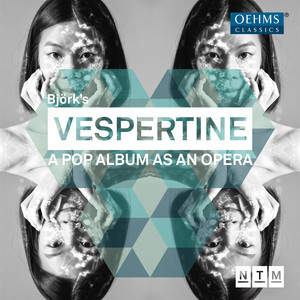
If you were an akward stoner teenager like me in the early 2000s, you probably listened to the original Vespertine, alone with headphones, while watching the snow fall or looking up at the cold, starry night. Even if the snow and stars weren’t literal, it’s impossible not to feel the crunching of the snow under your feet and the twinkle of stars above you in Bjork’s 2001 pop masterpiece Vespertine. An album revolving around micro electronic beats into an opera? How can this work? Bjork’s Vespertine is an electronic pointillistic completely surreal audio experince. Georges Seurat would have loved this album. Every micro beat and boop beep boop sound adds to a growing painting of winter, love, lust, and with the album ending with “Unison,” harmony. But to translate these electropopcorn bites into an opera setting? I had to hear it to believe it.
By the time Pagan Poetry plays, my heart is melting and I realize what a beautiful template Bjork has created for storytelling. Bjork has a history of making weird futuristic concept albums, and this album confirms that Bjork is probably a time traveler, finding melodies out of reach from the normal mind, and bringing it into our lives. The songwriting is something with which nothing can compare. No words can presicely describe the nuances that define Vespertine.
Bjork’s Vespertine as an opera is an earful of magic and wonder. The original lyrics and song order are mostly unchanged, save for a few additions to fill in gaps. The orchestrations and chorus keep your brain fully engaged for the duration of the album.
For me, it’s a time travel back to Aug 2001, a month before the US and world fell to its knees in despair. And we all sought solace in music, art, and prayer. This album is full of hope, dreams, and the artistic vision is clear and present. I highly, highly recommend this album.
“An Echo, A Stain” is my favorite from the opera. It took me years to understand the melody of this song. The baritone/soprano duet version here just… makes the melody soar even higher.
Poor, poor Woman in White. After her lukewarm Broadway run she disappeared into the shadows for over a decade. My impression is that US audiences found it boring and UK audiences found it… acceptable? I was a teenager when I bought the CD in 2005 and I was truly, deeply, madly in love with the score. I don’t know why, and I know my teenage hormotional rollercoaster adds a nostalgia bias. But damn, the music in this show is just gorgeous. I would like to point out that I’ve never seen this show and its visuals (which I’ve heard were at least good) are only in my imagination.
In highschool, this is what I assumed: Woman in White was never given was a proper, solid cast recording. The budget for the album was definitely 45ish$ that went to the soundboard guy to press the record button at the beginning of the show and the stop button at the end of the show. The album is, literally, a full unabridged recording of the show with no edits, cuts, or adjustments. Oh, except for a bonus track which is identical to a track we just heard near the end of Act II. The album finishes with a clunky, bumpy song that follows a beautiful finale. This album is so beautiful but much too complete and full of dialouge for me to recommend it to a present-day theater enthusiast. As a result, I made an abridged version for my own personal use and to share with friends.
Act 1: We begin with a dark frightning encounter between our protagonist(?) and the epynomous woman in white. I actually love this opening; it starts with the sound of fast moris code style clicking contrasted against an slower, offtempo sounding brass/woodwind that continues to build. And then suddenly a man screams “Oh my God!” and this driving 4/4 ascending piano bit starts and the two characters have a songversation. We are then introduced to the woman in white’s signiture theme (“You see I am no ghost” melody) with Angela Christian belting a tune so haunting it will give you goosebumps.
Following the prolouge, the tunes become uplifted as the characters are introduced and the score moves towards an almost “pastoral” 1850s painting vibe. Despite a somewhat slow to build beginning and ALWs absolute refusal to include any harmony in the duet “I believe my heart,” I am eager to hear more.
After two rousing renditions of Lammastide, a song which is creepy, repetative, and, entirely forgettable. It sounds like Andrew forgot how to write pop music momentarily as the chorus singing (again, no harmony) a robotic melody with a flute-accented downbeat so heavy, it kind of makes you motion sick.
Good news is that following Lammastide, the real beauty begins with the Holly and Ivy songversation into Maria Friedman’s tragic All For Laura. And then finally, the 3rd or 4th reprise of You See I Am No Ghost as the finale. In the edited recording I posted, the finale is cut a milli-second too short to breathe between Acts, but honestly, the actual final seconds are not noteworthy. When I remake this edit with a FLAC rip, I will change the akwardness of this track, and add a couple seconds to breathe before Act 2, and add back in the church bells indicating the beginning of Act 2.
[Intermission] Wow. I don’t know why harmony-less duets bother me so much. Am I missing something? Why wouldn’t you harmonize in a 4 minute love-ish song?What is it exactly about this melody that allows it to be acceptable without harmony? Am I over-reacting? Probably.
Act 2 begins with churchbells, which I edited out originally, oops. We get a few great solos, notably Evermore Without You, All For Laura Reprise, and You Can Get Away With Anything. And we also get treated with Lost Souls, a personal favorite of mine. It’s a fast paced choral number in 7/8 time, a catchy melody, and, thank you Jesus, harmonies galore.
The Finale is dialog driven, but there’s a nice medley of tunes from the show to underscore the creepy ending. At the very end, we get, the 18th reprise of You See I Am No Ghost (Okay, 5th?) and we finish the show with a ton of grunting and groaning and slapping from what is clearly a 2-minute fight onstage that we cannot see. The 12 minute finale I only cut down to 9 minutes, and it’s still awfully long. Especially with all the noisy stage fighting, it doesn’t make for a great listen.
But. Woman in White will always be one of my favorite broadway “flops” and I hope to see it return someday. (Worth noting, I know there was a 2017 West End revival, but there is little media from it and I never saw it). Maybe next time with a well produced cast album 😀
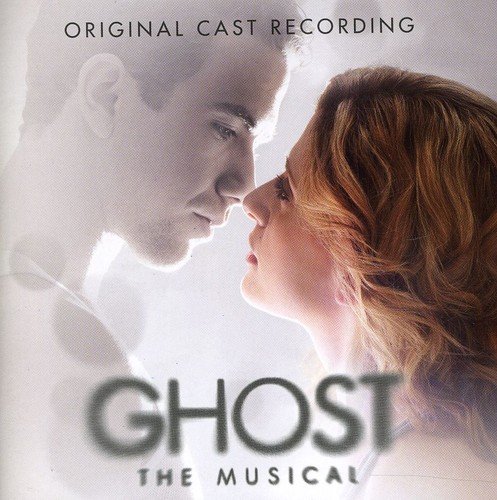
Full disclosure: this recording is not my favorite. Don’t let my grumpyness disuade you from eating up what Cassie has to offer though.
Enough time has passed since seeing the original Ghost film that I don’t remember anything except for Demi Moore’s haircut, which was unforgivable. The broadway production somehow went unnoticed by me during the early 2010s “Movie-turned-musical but only lasting a few months on broadway” situation. And Ghost was never a movie I ever considered for a stage adaptation, as I believed it to be locked in the 1990s vault for all time. I didn’t know who Cassie Levy was, nor did I know that Glen Ballard (of Jagged Little Pill fame) and Dave Stewart (of Eurythmics fame) composed the show. After obsessing over Cassie’s Elphaba, Elsa, and Fantine performances in recent years, I finally decided to give the album a new listen. After all, Cassie’s hair is much prettier than Demi Moores, so maybe there’s hope.
Act 1 – The show starts with characters Molly and Sam singing some cheesy pop songs (including a non-favorite song of mine, Unchained Melody) and suddenly Sam gets by a random Mexicann mugger, and then there’s a seemingly out of place song-and-dance tap number “Ball of Wax” set in a hospital and by this point in the album, I’m not sure where to put my emotions. Following this confusing number, a gospel number comes out of nowhere asking Molly and the audience “Are you a believer?” Am I sad? Confused? Cringing? Am I a believer? I’m not sure yet.
Finally near the end of Act 1, Cassie blesses us with the ballad “With You.” This is beautifully belting fantastic Cassie Levy in all her glory singing a great pop song with a haunting minor lift in the chorus (With youuuuuuuuuuuuuuuuuuu-oooooooooh). And finally the Act one finale comes and Molly “suspends her disbelief” with a 10 minute rock track with so much overlapping dialog and singing and another mexican bad guy? I’m not sure. Now I realize that I have no idea what the heck this musical is about. I’m hoping the second act is… less… confusing.
[Intermission] (You know how in A L Webber’s Joseph/Dreamcoat, every scene is a new music genre? Country line dancing into French accordian cliche ballad into calypso jam into 1970s disco jam “go go go joseph” into a sad ballad, into 1980s megamix. By the end, your brain is like “what is happening what universe does this story take place in and I feel lost” Ghost is – not as intense – but I wouldn’t say the score “flows” well. And I’m not sure why so many genres are being represented or what the writers “want” me to feel.
Act 2 takes us through ballad after ballad after ongoing dialogs about psychics and ghosts and love. Okay. This is fine. I’ve now read the synopsis and kind of get the gist, but near the end of the album, the not-so rockin’ rock song “I’m outta here” bleeds into an incredibly long dialog track / unchained melody reprise. It’s not until this track is over that I realize we’ve reached the actual finale of the show. Sam stops following around Molly and says goodbye in what is a very quiet anti-climatic ending. And now she has closure? I’m not sure. Do I have closure?! Even less sure.
The album concludes, after the finale, with a pop duet version of “With You” which is enjoyable. It remains the only track I can remember the melody of – everything else is a confusing blur.
Now, with all that being said, I will be keeping my eye out for future productions to see how the show has evolved as it seems to be staying alive somewhat across the pond in the European market. I actually do recommend the recording, dispite what looks like a long list of complaints (Sorry Glen Ballard) simply for Cassie Levy’s vocal performance. She could sing happy birthday backwards, drunk and with a pillow case over her head and I would probably still enjoy listening to it.
Ghost the Musical in its 2011 form is definitely a clunky mess of a musical. Fairly empty with brief moments of quality. Kudos to Cassie and Richard Fleeshman for trying to hold this erratic score together. I think I’ll stick to Jagged Little Pill or Frozen if I need to scratch my Glenn Ballard or Cassie Levy itch.

 100+ Years of Musicals