Nine (1982 Original Broadway Cast Recording)

Maury Yeston’s Nine (1982 Original Broadway Cast Recording)

Act 1
:
I was introduced to Nine around 2003 when the revival cast recording was released. As a teenager, I bought the CD on a whim, having never seen the show, but Yeston had an impressive reputation, and he had two major league shows win Best Musical at the tony’s by this point, and Jane Krakowski had some press coverage with her descending-from-the-ceiling-upside-down knockout performance of “A Call From The Vatican” (seen here if interested: https://youtu.be/UvhMAw6gCDw. Hearing Anita Morris’s version of the showstopper is a treat. Her almost manic finale combining belting, crying, high soprano notes, and vocal shivers, is really something else.

I did pause my listen-through of the 1982 Broadway Recording to reminisce on Jane Krakowski’s variation from the 2003 Revival, and I will admit, there is something almost perfect about Jane’s vocal rendition. I also, for the sake of objectivism(?), listened to the London (Becky Norman), Australian, Movie (P Cruz) and “Maury Yeston Songbook” (Alice Ripley) versions of the track as well.

The second half of act one unfolds with lush orchestrations and theatrical vocals with an obvious attention to the loony-ness and psychosis of some of the characters. Even in longer numbers like “Follies Bergeres”, and long song-and-dance-and-drama number sung in Franglais, where I literally don’t understand what’s happening for 8 minutes, Yeston’s score pulls me in deep regardless. It’s actually memorizing to hear the complexities of the overlays of vocals and orchestrations in this number. It reminds me of how good Les Miserable’s showstopper “One Day More”, or Rent’s “Christmas Bells” can be, even though it’s impossible to understand what anyone is saying.

The eponymous lullaby/choral number “Nine” sounds like it was written for his show Titanic, with a soaring melody and never a missed opportunity for flute heavy orchestration. Titanic, premiering in 1997 around 15 years after Nine, feels more like one long orchestral work turned into a musical, rather than a play with songs. (Also worth noting that Titanic is one of my favorite musicals and won the 1997 Best Musical Tony). The song “Nine” is later recorded as more of a solo number in the 2003 revival, where it loses some of his angelic, lullaby-esque feel.

By the time the Act 1 Finale track comes, I realize that every track so far has been extremely diverse in its musicality, while also maintaining a very classic Maury Yeston feel.

[Intermission]
A, very opinionated, side note: Maury Yeston’s Compilation album “Maury Yeston Songbook” is an essential album that belongs in every theatergoer’s collection. If for nothing else but Betty Buckley’s insane interpretation of Nine’s “Be On Your Own”

Act 2
Act 2’s favorite numbers for me include Be On Your Own and Unusual Way, but the Broadway recording doesn’t have the same oomph for these numbers as future recordings will. It might be worth it for me to compile the entire score as a playlist with my favorite versions from each recording, as it seems to vary widely among the songs. As well there are songs added from the motion picture soundtrack. Maury Yeston’s Nine was chosen to listen-through today because I haven’t given it a proper listen in years, and I’ve been on a Maury Yeston kick, having recently obtaining his Tom Sawyer ballet, as well as re listening to Titanic.

Concluding Thoughts
In short, this musical is amazing, and the score is enough to keep you enthralled, even if you know nothing of the story-line. The second act is stronger in future recordings, but nevertheless a fantastic album. Maury Yeston is an American treasure, I hope his works live until forever.
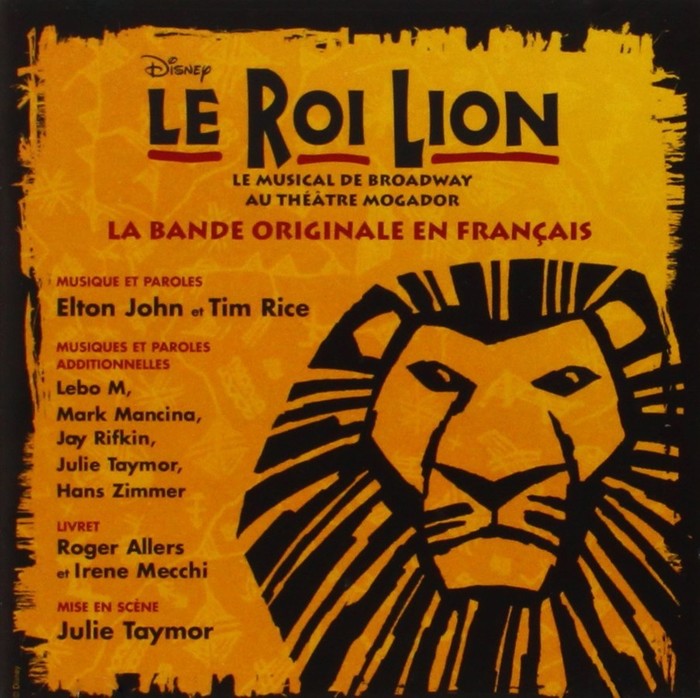
Lion King, The (2007 Paris Cast Recording)

Lion King (2007 Paris Cast Recording)

Ladies and Gentlemen,
a first time listen-through I am truly excited about. Elton John, Lemo M, Zimmer, and Julie Taymor’s masterpiece Lion King from 1997 took over internationally in the late 90s, much to the pleasure of everyone everywhere. In 1998, Lion King beat out Stephen Flaherty’s Ragtime for Best Musical, which most people say was a given, but let’s not forget that Lion King lost to Ragtime and Honk(!) in the Drama Desk and Oliver awards, respectively. In retrospect Julie Taymor and co were probably robbed of those. This is biased of course because I’ve never seen a professional production of Ragtime. And don’t worry everyone, Flaherty’s “Once on this Island” will go on to win the 2018 Tony for Best Revival.

I can’t believe Honk beat Lion King for the Olivier Award … 😦

Anyway, Act 1:
The Paris recording captures the perfect Circle of Life energy during it’s opening number. Rafikii is slightly more articulate with story telling diction than her American counterpart, but it’s a near flawless representation of the original production. Literally my only annoyance is the added syllable count in the French translation of “Circle of Life” (4) to Cercle De La Vie (5). I am not an expert in libretto translations though, so don’t mind me. The African chants of the first 10 minutes of the show come to an end with the ever annoying, and now cut, “Morning Report” or “L’Echo Du Matin.” We then remember that the first act of Lion King is more happy and G-Rated and the songs are catchy and silly and the Adults in the audience are awaiting the drama of Act 2.

Although some liberties were taken with various vocal lines, as well as syllables, the underlying score remains faithful to it’s original incarnation. The Paris cast does it’s duty well in preparing us for the overwhelming Act that is to follow.

[Intermission] (Only thoughts so far is: I can’t wait for He Lives in You, Shadowlands, and Endless Night)

Act 2
The African chanting at the beginning of act 2 remind me that there are some great songs are ahead after not understanding the jokes in Morning Report, Can’t Wait to be King, Hakuna, Hyneas songs, etc. In fact, we begin act two with Scar’s slightly creepy, slightly rape-y song Madness of Scar, where Scar tries to “Wed(!?)” Nala and our French actor does a great job convincing us that he, and his little hyena servants, are completely nuts and obviously pose a threat to the protagonists. Hearing it in French makes me equally uncomfortable and intrigued by this song, musically, and lyrically. After this nightmare (in a good way?) opening number, the show ascends into adult ballads with haunting African tribal chants interwoven with the melodies. Shadowlands and Endless night hit me hard back to back, and they really did well with these ballads. Adult Simba deliver’s Jason Raize’s (the original Simba on Broadway) emotional and desperate cry for help in a very beautiful way. After Raize’s unexpected passing in 2004 at the age of 28, this song has a deeper meaning for a lot of theater enthusiasts, as the song speaks so many words to so many people’s spiritual journey. I am pleased with this recording, so far, and I think Raize would be proud of this production.

A french sounding accordion leads us into Can You Feel the Love Tonight and I’m left wondering if there was an accordion in non-French productions. Cheesy a little bit, but Timon and Pumba are supposed to be, so it’s fitting I think. As we come to the end of the show we are left with one last song before the finale: Il Vie En Toi!, or He Lives in You, a song that even atheist theatergoers will attest to it bringing them closer to God. I’m being hyperbolic, of course, but I can’t emphasize enough the beauty and almost perfection of this song. The reprised version of the Act 1 “They Live In You” brings Rafikii in to offer some encouraging (French) words to our protagonist, and soon the chorus joins in and Simba finally exclaims “Il Vie En Moi!” indicating the spiritual song has done its duties in helping Simba understand his role.

As “Simba Se Confronte A Scar” plays a couple minutes of intense instrumental battle music, I can’t help but appreciate the quality of musicianship put into this recording. Everything sounds very tight, well rehearsed, and the electric guitar solo in the Confrontation is a nice little showcase of this.

Our last moment of triumph is celebrated with a mixture of African chanting, French words, and the famous Lebo M/Zimmer/John sound. The harmonies are on point in this finale as Simba ascends to the top of Pride Rock.

Concluding Thoughts
Worth noting that this production ran for almost 3 years and won the 2008 Molière Award (French Tony) for Best Musical. It is absolutely one of my favorite foreign cast recordings and will always bring me back with its almost incalculably gorgeous second Act and beautiful translation.

9/10 without doubt and if a bootleg of this production ever comes up, I would pay money for it.

Glorious indeed! xoxo -a.b.

Dracula (2008 Original Graz Cast Recording) [Wildhorn]


Ladies and Gentlemen,
First and foremost, it’s been a while since reading, watching, or listening to anything related to Dracula, so this review is a long time coming. I am slightly familiar with the English language concept album that was released two years prior to this productions. I usually prefer Wildhorn’s “international” casts over West End or Broadway-bound albums. Maybe because the lyrics are not one of the major reasons I listen to a Wildhorn album (for contrast, I find listening to Sondheim or Bernstein shows in foreign languages as I am so in love with the libretto.) I usually describe Wildhorn shows as page turners, in that each love duet and baritone solo leaves you wanting just a little more, and, for me, he often delivers (minus his attempt at his musical Wonderland.)

Act I
I tend to be a harsh critic of opening numbers, so I tried to be objective in my review of the beginning parts. It begins with some whispers and minor violin riff into a decent baritone/tenor solo, mirroring Wildhorn’s pièce de résistance Jekyll and Hyde from 1997. After a soaring love duet, Wildhorn starts throwing some rhythmic curve balls to the listener. I expect a Wildhorn score to be a “page-turner-edge-of-you-seat,” as it is a genre or style he is best at. His constant back and forth between 6/8 and 4/4 is always a treat. I will admit, as we start to hear quite a few fast 6/8 waltz bits near the end of act 1, I’m left curious if the second act will mimic the first. The show draws its listeners in similar to Jekyll in its beautiful and sad duets. The first act takes a couple songs to draw me in completely, but it succeeds by track 4 or so.

The Act 1 finale: we are met once again with a powerful duet between Dracula and Lucy. I enjoy it enough to give the Act 1 Finale a second listen before “intermission.” What I like most about the finale is the electric guitar tap-tap-tapping that draws you into a brass, drumset, electric guitar soundscape. It begins a Dracula solo, the chorus moves into 4/4, of course, and keeps us on our toes, and Lucy enters about a minute before the last note. Just in time to wrap up this Act and give us some juicy Wildhorn harmonies with rhythmic changes throughout. A page turner indeed!

[Intermission]
(I had no idea if that was the Act 1 finale, as this is a one disc recording, by the way, and took time to figure it out, only to remember my German is bad enough to not be able to figure it out. Oops. But what I assume is the finale most definitely left me “hanging” (musically.) and eager to hear the second act.)

Act 2 (maybe…)
The act opens with a female solo this time around. It could very well be a reprise of another song, as some of Wildhorn’s melodious solos “have a certain sound to them.” Not bad by any means, but sometimes his songs blend together in my mind. The standout female led solo “Wär ich der Wind” (English: “I would be the wind”) tells me by this time that we are definitely in the second act and the drama is heating up. And I know my favorite number Before The Summer Ends is around the corner, as it’s near the end of the show. Immediately prior to my favorite song, a song called “Deep in the Darkest Night,” is heard. It’s a semi-jolly, Scarlet Pimpernel sounding 4/4 march that I believe originated as one of the opening numbers of the show. But, true to Wildhorn’s Producers: if it doesn’t work, try something else and see if it works. In this case, put the song somewhere else. The show comes to an end with couple of Dracula power ballads, include my aforementioned favorite. After a 15-20 minute run of ballads, the finale starts.

The Act 2 Finale: Same minor strings as the very beginning of the show, followed by(, surprise,) a male/female belting power ballad duet. The ending, which I won’t spoil, is slow and somber, and we are left with two voices sadly singing acapella before a sudden resounding burst of trumpets and electric guitars give us the final taste (pun) of devastation and tragedy as the music comes to a end.
Concluding Thoughts & TL;DR
All in all, the orchestrations tend to be easy on the ears and string heavy, which makes the album feel more relaxed, chill, or even somber. It has moments of tension, usually with an electric guitar doings its proper role. It’s no lie that if I am choosing an cast album to listen to quietly while I fall asleep, Frank Wildhorn’s shows usually cross my mind. There is always drama though.

Unlike Andrew Lloyd Webber, Disney Productions, or Kander and Ebb shows, which present internationally true to their original Broadway/London production, Wildhorn productions typically adapt and change through revision after revision and constantly improve over time. It’s fun to watch his shows evolve over my lifetime, as I’ve been listening to his musicals since I was a child.

I’ve been impressed with Austria’s productions over the last 20 years, at least with regards to music production and quality of artists involved. I find Wildhorn’s shows tend to age quite well, by which I mean the productions and revivals have improved following it’s initial run. Also worth mentioning that Wildhorn’s Jekyll & Hyde spent something like 10 years in pre-broadway productions before the show existed as it does today.

Much better than the earlier English concept album. This is my first full listen of the album, and I enjoyed it quite a bit. 7 or 8/10

xoxo – a.b.